Tag: I

  • 2018/19 Season: La liga to use VAR for 380 matches

    NationSport can report that Video Assistant Referee (VAR) will be used for the first time in La Liga following its success at the 2018 FIFA World Cup.

    The VAR technology will be used for all the 380 matches of the La Liga Santander 2018/19 season.

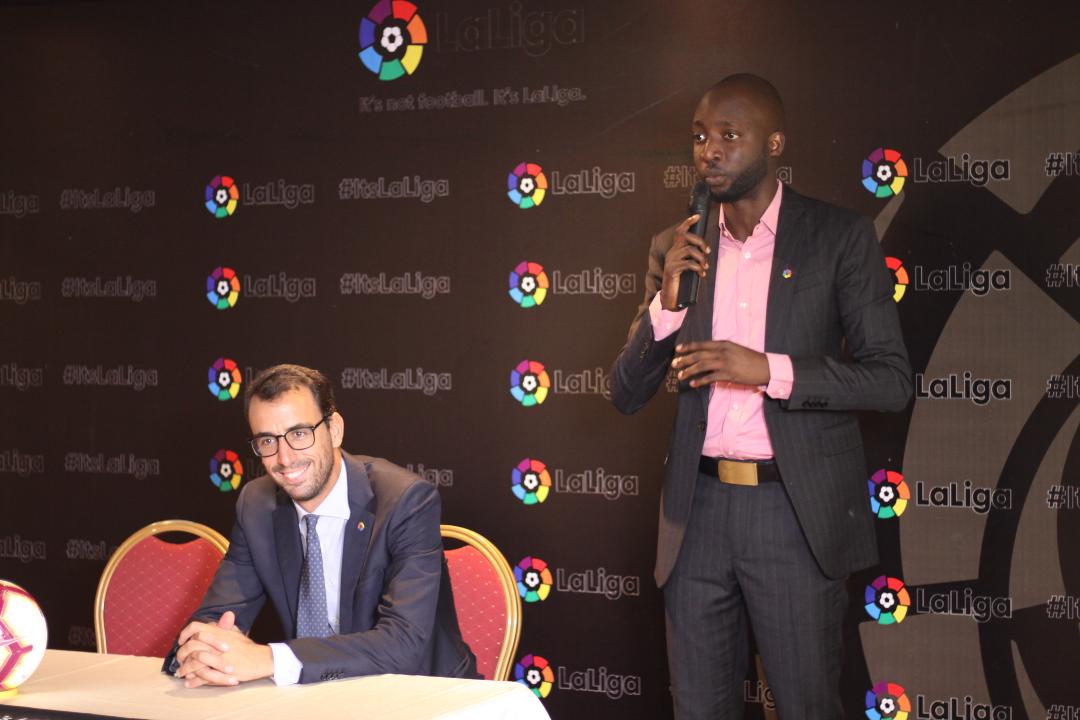
    Country Manager LaLiga Nigeria, Javier Del Rio, Media and Communications Coordinator LaLiga Nigeria, Ayodeji Adegbenro, confirmed this at the 2018/19 LaLiga Season Kick-Off Media Briefing Session, in Lagos.

    It was gathered that LaLiga Santander broadcasts will be of the highest possible standard, with Skycams, the Intel True View system and 4K production set to be a permanent fixture, as all 20 stadiums are now equipped with the requirements for these cutting-edge transmissions.

    “There have also been two significant advances on the technology front, with the most up-to-date broadcasting technology now implemented to bring the spectacle to screens around the world, as well as the introduction of VAR. The first of 38 LaLiga matchdays kicks off on August 17th,” the officials said.

    2018/19 LaLiga Santander season, has witnessed a flurry of activity in the transfer market, three clubs fresh from promotion from LaLiga 1|2|3, and stadiums better equipped than ever to give fans the most thrilling experience possible.

    Photo Caption from L-R: Country Manager LaLiga Nigeria, Javier Del Rio, Media and Communications Coordinator LaLiga Nigeria, Ayodeji Adegbenro, at the 2018/19 LaLiga Season Kick-Off Media Briefing Session, in Lagos

    The 2018/19 LaLiga Santander season will, of course, have three new teams on board, in the shape of SD Huesca, Rayo Vallecano, and R. Valladolid CF. It will be Huesca’s maiden season in the Spanish top flight and the club’s participation in LaLiga Santander will put the city of just 50,000 inhabitants on the map.

    While Huesca is new to the elite of Spanish football, Rayo knows the division well: they are now set for their seventh stint in the top tier. Top-class football will be returning to the Madrid neighbourhood of Vallecas, which gave fantastic backing to their team last season. Last but not least is R.

    Valladolid, who are back in the big time after an absence of four years and will be the only LaLiga Santander club flying the flag for the autonomous community of Castilla y Leon. Part of the renowned wine region of Ribera del Duero, Valladolid has common ground with D. Alaves, the Basque clubs and the aforementioned Huesca in being an important centre for viticulture.

    Aside from new clubs, there are plenty of fresh faces whom fans will be keen to watch. Star names from across the globe have joined LaLiga Santander clubs, the most eye-catching transfers being Chile’s Arturo Vidal to FC Barcelona, France’s Thomas Lemar to Atletico Madrid and Peru’s Luis Advincula to Rayo.

    Three other notable names heading to pastures new within Spain are Mexico’s Miguel Layun, who has joined Villarreal CF, Nigeria’s Moses Simon, who has joined Levante, and Japan’s Takashi Inui, who has signed for Real Betis. The transfer window doesn’t close until August 31st, so LaLiga Santander clubs still have plenty of time to add quality to their ranks.

    No fewer than 380 nail-biting encounters, heightened emotions every matchday and the agony and ecstasy that await the culmination of the season are all things that will make the LaLiga Santander 2018/19 season a unique spectacle. Let the games begin!


  • Maitama Sule and I

    Maitama Sule and I

    I met Maitama Sule three times. Twice at the Nigerian Institute of International Affairs in the early 1990s.They were debate sessions. We sparred over the state of the country, journalism, international politics. In his colourful babanriga, feisty spirit and ringing voice, he spoke with me as though we were contemporaries. We were at polar points but we exchanged ideas with cheer. He came across as a profound follower of news and events around the world. Our last tango was about American anchor Walter Cronkite. He wished we could replicate his stature. Cronkite made President Lyndon Johnson not to run for re-election.

    The last time I saw him, he could not see me. I was compere at a book launch. He grabbed my hands and poured out a visceral prayer. It was a divine meeting. As he goes home, I also pray for him from the bottom of my heart. He was a great man.

  • NiMet predicts cloudy, rainy weather for Thursday

    The Nigerian Meteorological Agency (NiMet), has predicted cloudy conditions with localised rains over Mambila Plateau, Jalingo, Lokoja and Makurdi on Thursday morning.

    The predictions are contained in the Weather Outlook issued by NiMet’s Central Forecast Office (CFO), in Abuja on Wednesday.

    The agency predicted localised thunderstorms and rains over Abuja, Bida, Ilorin and Minna in the afternoon and evening with day time temperatures of 29 degree Celsius to 30 degree Celsius.

    NiMet predicted that the Northern states would experience thunderstorms over Gusau, Katsina, and Kano in the morning with day time temperatures of 31 degree Celsius to 32 degrees Celsius.

    According to the prediction,there will be prospect of rainfall activities rains across the country in the next 24 hour.

    NiMet also predicted that the Southern States would experience chances of rains over Calabar, Ogoja, Enugu, Akwa, Port Harcourt and Eket in the morning.

    It added that Osogbo, Akure and Iseyin would have localised thunderstorms in the afternoon and evening with day time temperatures of 28 to 29 degrees Celsius.

  • Building a world-class varsity (I)

    In 2009, Dr. Jamil Samli listed what constitutes a “World-Class University” in a publication for the World Bank: “The challenges of Establishing World Class Universities.” According to Samli, a world-class university has three distinguishing outcomes: first, highly sought graduates; second, leading-edge research; and third, dynamic knowledge and technology transfer. Samli attributed these outcomes to three complementary sets of factors at play in these universities.

    The first factor is a high concentration of talent, consisting of faculty, students, researchers and internationalisation. The second factor requires favourable governance features that encourage leadership, strategic vision, innovation, and flexibility and that enable institutions to make decisions and manage resources without being encumbered by bureaucracy. The third factor consists of abundant resources to offer a rich learning environment and to conduct advanced research. It is therefore the dynamic interaction among these three factors that defines world-class universities.

    Three years ago, BrandiQ – a highly intellectual brands and business focused news magazine that I’m involved in – started a project aimed at establishing BrandiQ Clubs across tertiary institutions in the country. We identified a lacuna between theory and practice in the integrated marketing communications (IMC) industry and the need to bridge these lacunae through the production of world class intellectual materials and in-depth mentoring of undergraduates across several disciplines.

    Our first point of call was Redeemer’s University Ede, State of Osun where we were received with open arms. The varsity was then operating from its temporary site inside the Redemption Camp in Mowe, Ogun State. From that humble start, the tentacles of the club has spread to several institutions, particularly in the Southwest.

    It was, therefore, gratifying when we received an invitation from the club President, Maryann Okonkwo, inviting us to their inaugural lecture and award with the theme: “Building a World-Class University: The role of Brand Management.” They solicited our support in sourcing for a credible and knowledgeable resource person(s) with a vast knowledge in global brand management to deliver the lecture and also give their institution a road map.

    We persuaded two well-known and respected individuals in the IMC industry – Mr. Bola Akingbade, former CMO of MTN and Mr. Rufai Ladipo, former MD STB McCann – to do justice to the topic; and what an exciting time it turned out to be for everyone that attended.

    To show the importance they attach to the lecture, the Vice Chancellor, Prof Debo Adeyewa and other principal officers of the institution – the registrar, bursar, librarian and deans of colleges/HODs – sat and listened attentively during the almost three hour lecture.

    In his lecture, Akingbade said the expression “World-Class”, means “amongst the very best in the world”. It is an expression that has been increasingly employed to underline the “Internationality and Excellent Quality” of all forms of both “tangible and intangible” benefit carriers. “I belong to the school of thought that believes very much in the relentless pursuit of world class ambitions, goals and purposes. This is because the pursuit of globally recognised excellence in any endeavour is absolutely necessary to guarantee the attainment of feats and heights that are uncommon, from a global standpoint, and which deserve to be proudly celebrated on the world stage.”

    He buttressed this point by saying it is no longer “unusual” or “implausible” for a citizen of any country outside the UK, for instance, to choose a world class and well renowned institution like Cambridge University, over and above every other University in his home country, for his tertiary education. Indeed, if the challenge of meeting the admission criteria does not constitute an insurmountable barrier, it will be unlikely for this student, to jettison the opportunity to go to Cambridge in favour of a local and less highly regarded University alternative.

    The situation will be the same for Universities in any country, where available Universities therein are not seen to be capable of offering the “world class” benefits/values that are widely associated with highly regarded tertiary institutions. If this tendency is not challenged, the result will be that these “not – highly – regarded Universities” anywhere in the world, would not be able to attract the top echelon of very good students, faculty, and/or Research grants, either from within the local environment or anywhere else in the world. “It is not difficult to predict the ‘cheerless future’ that awaits such institutions!”

    So, what’s the role of brand management in achieving this? The key objectives – according to our lecturer – include facilitating the steady and speedy transition of the mainstream university into the “World Class” status that is desired – over a specified – but realistic space of time. This firmly establishes clear preference for the university in the minds of a sufficiently large number of topflight students from different parts of the world within the set timeframe.

    The varsity must be essentially driven by the need to gain recognition, first as an aspiring “World-Class” institution, and, ultimately, as a “proud member of this elite group” within the realistic timeframe. The mandatory steps in the process of adoption and application of the strategic management principles inherent in this approach – he pointed out – include professional understanding of the meaning and significance of the “Brand”, both as a concept and a strategic tool for business growth;

    In the mind of our lecturer, a clear understanding of the process of leveraging the “Brand” for a full establishment of its customer connection potential is a fundamental prerequisite. Also important is the acquisition of strong insights into the “drivers of choice” amongst “topflight” students, world class faculty members, donour agencies and discerning and top rated employers of university graduates.

    Systematic application of insights for the “injection of appropriate and superior benefits values” into the University Brand Essence, and for the subsequent development of a winning “Value Proposition” for the University should also be desired. Strategic leveraging of the “Value Proposition” for consistency with the evocations of the “Brand Pillars” and systematic “Brand Building Structures and Action” will further drive the aspiring varsity toward world standard.

    Another key essential is the “Product” or “Physical Manifestation” Pillar: This – he enthused – refers to both the “intrinsic” and “extrinsic” values of the physical manifestation of the Brand. It speaks to the “Functional Benefits” of the Brand (i.e. the potential to give the target customer a veritable reward for the adoption of the offering). In particular, emphasis should be focused on unique facilities and environmental features that set the brand apart, first as one of the best amongst its peers, and as a potential world class institution. As a rule, these reward elements or components must be visible and, must come across as tangible benefits.

    Next is “The Personality or Social Standing Pillar:” This – Akingbade stated – is an expression of what the institution would look like if it were a person or a physical entity. This usually comes in various descriptions as follows: Masculine/Feminine; Elegant/Ordinary; Smart/Reticent; Handsome- Beautiful/Ugly; Accessible/Clumsy; International/Local; World Class/Ordinary, etc.

    Each one of these associations comes with perceptions that can shape the opinion of target customers concerning the suitability or otherwise of the Institution for their purposes. It is therefore important to ensure that knowledge of customer insights on drivers of choice are excellently leveraged to guarantee the projection of the right image/personality for the Institution.

    “The Symbols and Symbolisms Pillar” is also part of the mix. It is the combinations of design elements, logos and colours that have been adopted for the brand. By definition, these must be very pleasing to eyes and mind, and must also convey the images of international quality, class and style for the institution.

    The uniqueness and attractiveness must be so striking and unique to the extent that the brand will readily come to mind, even if the symbols are made to feature as “stand alone” images. It is absolutely essential that the process of evolving the character and value associations for each of the brand pillars must end up with a consistent message that will define the brand as envisioned. In other words, if the adopted “Heritage” values are presenting the brand as “international”, the defined value associations with the physical manifestation pillar should not be evocative of anything else but international values.

  • The tragedy of the Nigerian youth (I)

    In 1989, I was inside a cab with three other students on our way to the main campus of the University of Jos when we encountered a large group of protesters, mainly youths and fellow undergraduates. Our cab was forced to stop because we couldn’t proceed beyond the Jos main market. Hours later, we learnt that the protest we encountered happened nationwide.

    It was later dubbed the “anti-Structural Adjustment Programme (SAP) protests.” Nigerians trooped out in their millions to vent their displeasures and anger on General Ibrahim Babangida’s regime for the adverse effect SAP was having on them. It was spontaneous and did not have a clear cut leader or organisers’. Nigerians were simply angry and they made the government realise this.

    Being the smart and cunning ruler he was, Babangida immediately carried out remedial and palliative measures that ended up giving SAP “a human face” different from the earlier “face of a demagogue.” This new “face” calmed frayed nerves and he was able to remain in the saddle of power until events of the post 1993 election forced him to step down a day earlier than necessary. This was the power of protest in its finest.

    Fast forward to 2011; Time magazine, an international news magazine of repute often take its time when it comes to nominating its “Person of the Year,” and whenever it does, few doubt its choice. In 2011, the magazine made the “Protester,” its “Person of the Year.” The October 20th issue of the Magazine was titled: “The Face of Protest.” The reason for this was not farfetched.

    On 17 December 2010, a young Tunisian street vendor, Mohamed Bouazizi set himself on fire in protest of the confiscation of his wares and the harassment and humiliation that he reported was inflicted on him by a municipal official and her aides.

    His rare act became a catalyst for the Tunisian Revolution and the wider “Arab Spring,” inciting demonstrations and riots throughout Tunisia in protest of social and political issues in the country. The public’s anger and violence intensified following Bouazizi’s death, leading then-President Zine El Abidine Ben Ali to step down on 14 January 2011, after 23 years in power.

    The protest did not end in Tunisia as Libya’s long standing ruler and the boisterous Muammar Gadhafi as well as Egypt’s Hosni Mubarak was overthrown. Bashar Al Assad of Syria is still battling his own demons, an act that has probably set back a century back, according to some analysts. Few doubt that the season was indeed the season of the protester.

    The domino effect of these were also felt in Nigeria with the emergence of the “Occupy Nigeria” group which eventually fizzled out after government invaded their meeting point after an ill-advised break.

    The lesson for us is that there will always come a time that people feel they’ve had enough and will insist on change. Only a week ago we saw how the people of Burkina Faso took to the streets and burnt down their parliament building following reports that Blaise Campaore, their ruler of 27 years, was bent on tampering with the constitution yet again to extend his rule. He resigned three days later. Again the protesters won.

    While the youths of other countries take their destinies in their hands and call for authentic change, it is disheartening to see our own youth’s busy giving award after award to dubious and questionable characters in the name of “progress.” They are also at the forefront of “endorsement” of one candidate or the other as 2015 inches closer. Student bodies that ought to know better – to me – seem to be the worst culprit.

    Why are our youth no longer angry at certain situations? What future do we really have? Let me make it clear before I proceed that my intention is not to call for violent protests or revolution, but peaceful protests that would compel those in authority to listen, and by listening we can begin to put our heads together to find solutions for the plethora of problems confronting us. There are critical issues that demand the attention of our youths because the future really belongs to us.

    I am seriously concerned about the growing insecurity in the country, by this I mean the Boko Haram (BH) insurgency and the spate of kidnapping for ransom. And why am I concerned? Development and economic progress can never take place in an insecure entity. Investors simply love peaceful places where their investments are secure. The United Arab Emirates created their paradise because of peace and security, and today, their cities are the toast of the capitalist world and the playground of corrupt African officials. They put their house in order first.

    Who are the foot soldiers of BH? Mainly the youths, in essence it is a Youth war. So, why would sane Nigerian youths not feel a sense of revulsion given that it is their collective future that is apparently going up in flames? The sad fact is that most of our youth feel BH is a “Northern problem,” rather than a Nigerian problem. While there are cries of conspiracy theories and the activities of fifth columnists’, it is high time we confront this monster before it consumes us all.

    By now, I was hoping to see massive peaceful youth protests against the excesses of BH which has the potentials of destroying the seeds of our collective future. Sadly, comedy, Nollywood and music have sucked and seduced our youth into a false sense of security and prosperity. There is an urgent need to channel youth frustration into a more productive means of engaging government across the board.

    Most of our past leaders assumed leadership positions in their early 30s, some even younger. But today, some youth of that age still depend on their parents or family members for support; such is the tragedy of the Nigerian youth which the insurgency is further aggravating. This is the main reason they shouldn’t see BH as other people’s problem.

    Another reason for my concern is that we are gradually building a generation of crises prone youths. As a historian, I am familiar with studies of post conflict societies where children who have been through war in such places as Liberia, Sierra Leone, Rwanda, Somalia, Serbia, Afghanistan, Bosnia or Syria have a tendency to express themselves in war metaphors. They draw guns, bombs, and armoured tanks as a past time. They take pleasures in these weapons of mass destruction rather than their books.

    Today’s youth, rather than being obsessed with just making money and craving for champagnes, fast cars and luxurious apartments, must begin to critically ask how today’s bitterness will affect his tomorrow. A time will come when entertainment and music will make no meaning.

    I’m concerned about this critical constituency because they are the once that effect change elsewhere. For instance, the American youths were angry about Vietnam. They took to the streets in revolt when thousands of their fellow citizens were being killed in a senseless war. The youth in China were angry about the lack of openness in their society and they took over Tiananmen Square.

    Do we still remember the picture of the young man facing the armored tanks in Tiananmen Square or the Burkinabe facing AK 47 wielding soldiers only last week in Burkina Faso ? Also, in 1976, youths in Soweto were angry about being asked to learn Afrikaans by force even though their teachers did not know the language and it was the language of domination. They revolted. Today, the iconic picture of the dead body of Hector Pieterson remains in public memory worldwide.

    Perhaps I should continue? Malala Yousafzai, the young Pakistani girl shot in the head by the Taliban on her way back from school is today, at 17, an iconic young girl. She has gone down in history as the youngest person to receive a Nobel Prize. Understandably, the award has elicited controversial reactions, but that is not the issue. She now has a Malala day marked on the international calendar to remember her heroic achievement.

    Did you, by chance, listen to her recent speech at the United Nations?  This young lady said she drew inspiration from Jesus Christ, Martin Luther King, Buddha, Gandhi, Mohammed, among others, despite being a little Muslim girl. As far as I’m concerned this is clear evidence of a young mind that had opened up and escaped the bondage of prejudice and hate.



  • The dilemma of tertiary education (I)

    Two weeks ago, the mug shot of a felon in California, the United States of America (USA), Jeremy Meeks was posted on the internet by the police department’s Facebook page. A few hours after it went viral, the mug shot earned him hoards of admirers with mainly ladies commenting on how “handsome” he is.

    If that was the end to the story it would have been better; but wait for this, it secured him a Hollywood agent who is already negotiating modeling contracts for him even though he is a felon and still in jail! Can you beat that!

    Perhaps I need to point out that Jeremy Meeks was arrested as part of a sweep of gangs in Stockton, California, and faces a felony weapons charge. It was reported that the agent, Gina Rodriguez has signed Meeks, 30, as a client and he joins a roster of her other notorious celebrities.

    So what are the prospects for a modeling career for the “handsome” felon? “Jeremy has an amazing look and has received international attention which I feel can only help him flourish in the entertainment industry,” Rodriguez was quoted as telling ABC News in the US.

    Not done with her high hopes, she added: “Jeremy could make somewhere between $3,000 to $100,000 per month through endorsements and modeling. We are also speaking with several production companies about following Jeremy’s foray into the entertainment industry.”

    As “good” as this may sound, there is one big hurdle preventing any immediate modelling windfall; Jeremy is behind bars on $1.1 million bail. The story gets interesting when it was also reported that a woman claiming to be Meeks’ mother launched a “GoFundMe” campaign to raise money to pay for his release.

    In the description, she insisted that he has no gang affiliations in spite of the charges filed against him. “He has old tattoos…which cause him to be stereotyped. He’s my son and I’m just trying to raise funds to help him in any way. Please help him to get a fair trial or else he’ll be railroaded,” his mother Katherine Angier wrote. So far, they have raised over $5,000.

    You might be wondering what this has to do with tertiary education in Nigeria. I recounted this true story to drive home the fact that the postmodern society we live in is a complex one that defies logic and reasoning in some cases. I have discovered that society often place premium on things that in most cases add little or no value toward progress. The story I just recounted may have happened in the US, but some of the people that admired the “handsome” felon were Nigerian youths. The world is now a global village without barriers.

    For some time now, there have been rumblings in Nigeria’s tertiary education sector. From Lagos to Ife, Anyingba to Keffi and elsewhere students have taken to the streets to protest upward review of fees charged by their respective institutions. Authorities in some of these institutions have tried to give reasons for these reviews, but they often met a brick wall of resistance in the process. What then are the issues?

    In answering this question, I’d like to come back to the issue of the society. The society sees nothing wrong in building a multi-billion naira entertainment centre, but will struggle if asked to contribute to the building and equipping of a science laboratory. The same society will also see nothing wrong in the sponsorship of a beauty pageant, but will struggle if it comes to the sponsorship of a readers’ club, for instance. The list is endless.

    This was what made Oscar Wilde to say that we humans are not rational but sentimental beings. I quite agree. What would make young ladies “fall in love” with a character like Jeremy Meeks?

    Now back to the rational world. With series of strikes and other internal crises bedeviling the sector, there is little doubt that tertiary education is at a crossroad in Nigeria whether we choose to accept it or not, and we have to think fast on how to start putting it back on the right track otherwise we’d be doomed as a nation; some say we are doomed already.

    One thing is very clear here, we all seek a good education, because a good education is the root of a prosperous society, but how this “good education” metamorphoses is the million naira question. The dilemma we face in Nigeria is this: Do we want a cheap education that makes mess of progress or do we seek an expensive education that restricts access? That is the dilemma of tertiary education in this country. While we are grappling with this dilemma, hundreds of thousands of ill equipped and unemployable graduates are being churned out annually.

    While in the university, I joined fellow students as we marched to the office of the Dean of Student Affairs to protest hike in library and other fees – tuition was absolutely free back then, and the increase was not more than N100! The dean took his time to educate us that the paltry fees we pay were not up to a fraction of what he is paying for his daughter in kindergarten! You guessed right if you say the students almost stoned him. That mindset has not changed to date.

    Against this backdrop however, it will be pertinent to point out that all the great universities in the world are not cheap. But that they are not cheap does not foreclose the fact that indigent but brilliant cannot have access to them. There is a reason why they are accessible to the brilliant and ambitious: The government invests and the society plays its unique part in form of scholarships, infrastructure upgrade, provision of books and teaching aids alongside other sundry funds.

    While this is the norm in sane societies, ours is farther from the truth because those that often secure these scholarships are those ‘connected’ to the powers that be, no matter how dull they are. It will shock many Nigerians the number of foreign scholarships that are awarded in the country to people who least deserve them. Herein lay another dilemma.

    In Nigeria, the rich are not investing in our education because they claim they have no stakes, or where they have stakes, they invest for selfish reason of boosting their ego. They are least concerned because their children attend the Oxfords, Cambridge, Harvard or Yale of this world.

    While the rich shy away, the government is equally bereft of ideas on how to make education qualitative and to some reasonable extent affordable. Where the idea thrives, the “political will” to carry it out is a different ballgame altogether. In the US, for instance, many students have access to loans that often see them through the university. They pay back when they start working, President Obama paid off his loans when he was a senator! But I can hear you laughing and saying where is the work in Nigeria? I agree, but can we at least try it as a pilot project?

    Toward the end of last month, the Economist magazine ran a cover story titled “creative destruction.” It centers on how universities can reinvent themselves and remain relevant in a rapidly changing world. This goes to show that the problem is global and not restricted to Nigeria. But the difference here is that other are already thinking ahead of time.

    In the report, the magazine argued that a cost crisis, changing labour markets and new technology will turn an old institution on its head. Higher education – it rightly pointed out – is one of the great successes of the welfare state which most western societies adopted to cushion the harsh effects of unbridled capitalism. What was once the privilege of a few became a middle-class entitlement, thanks mainly to government support.

    It said that “in the emerging world universities are booming: China has added nearly 30m places in 20 years. Yet the business has changed little since Aristotle taught at the Athenian Lyceum: young students still gather at an appointed time and place to listen to the wisdom of scholars. Now a revolution has begun thanks to three forces: rising costs, changing demand and disruptive technology. The result will be the reinvention of the university.”

    Is Nigeria ready for such reinvention?

  • PDP: by-election devoid of irregularities

    PDP: by-election devoid of irregularities

    The Peoples Democratic Party (PDP) in Ondo State has said the by-election in Ilaje/Ese-Odo Federal Constituency, which was declared inconclusive by the Independent National Electoral Commission (INEC), was devoid of irregularities.

    It was reacting to a statement by the All Progressives Congress’ (APC’s) candidate in the by-election, Chief Adewale Omojuwa, who called for the cancellation of the poll on grounds that it was marred by irregularities.

    Omojuwa accused Labour Party (LP) and PDP leaders of turning the constituency into a battlefield and urged INEC to conduct a fresh by-election.

    But the PDP, in a statement by its Publicity Director, Ayo Fadaka, described Omojuwa’s claim as false and “a dishonest account of developments in the area”.

    PDP said: “Truly, Governor Olusegun Mimiko relocated to the area in the weeks leading to the election, but that is not true of the Minister of State for Defence, Musiliu Obanikoro, who merely came to Ajapato to address a campaign rally in the same way any political leader will seek to help his party. He left on the same day, so where lies the battle in this effort?

    “Special Adviser to the President on the Niger Delta Kingsley Kuku was around days preceding the election because he had a ballot to cast and also because as a PDP leader, it is normal to be in his constituency.

    “As for Chief Olusola Oke, a leading light in the party to whom Omojuwa was an acolyte, he is a private citizen and, therefore, has is free to deploy his time to whatever venture he so desires.

    “It is a known fact that the use of the military as security back up on election days predates Obanikoro’s appointment as minister, therefore, the lame mischief of Omojuwa in this regard is impotent. We condemn this dishonesty.”