Tag: Mexico

  • Earthquake kills at least four in Mexico

    Earthquake kills at least four in Mexico

    At least four people were killed in a powerful magnitude-8.1 earthquake that hit off the South-Western coast of Mexico, toppling buildings and triggering tsunami warnings on Friday.

    The quake was centred about 87 kilometres off the state of Chiapas and struck at a depth of 69.7 kilometres at 11:49 p.m. on Thursday (0449 GMT Friday), the U.S. Geological Survey said.

    Two children died as a result of the earthquake, said Arturo Jimenez, the governor of the state of Tabasco, located north of Chiapas.

    One of the children died at hospital after a power failure caused life-saving equipment to stop operating while the other was killed when a wall collapsed, he said.

    In Chiapas, two women were killed by falling debris, according to local media.

    Waves surging more than three metres above normal tide are possible along the coast of Southern Mexico.

    Waves reaching up to one metre could take place in Central American states and in western Pacific islands such as Fiji and New Zealand, the Pacific Tsunami Warning Centre said.

    The shock was felt in the capital Mexico City, about 1,000 kilometres away, where frightened residents fled from swaying buildings and into the streets, many of them in their nightdresses.

    Patients were evacuated from some hospitals across the quake zone as a precaution.

    Classes were cancelled on Friday across southern Mexican states in order to inspect buildings to make sure they are structurally sound.

    Electricity was knocked out in several areas of the country.

    In neighbouring Guatemala, President Jimmy Morales said damaged assessments would soon begin. “Please remain calm,’’ he urged on Twitter.

    Mexico has substantial quake activity and is also prone to other natural threats such as hurricanes, floods and volcanoes.

    On Sept. 19, 1985, thousands were killed when two violent earthquakes destroyed large parts of the capital.

  • Sucker-punch, like Mexico

    Mexico is clearly not what you would call a fair match for the United Stares in many regards – not in military armoury or economic fortunes, for instance. But that Latin American country lately showed a markedly superior edge in moral high grounding over its illustrious neighbour.

    United States President Donald Trump, even before assuming office last January, had for much of his public life made a favourite punching bag out of Mexican immigrants (Latinos) in his country, and without sparing a breath for their home land of Mexico. He flagged his prejudice most luminously when he kick-started his stumping for the American high office on June 16, 2015 with diatribes on Mexico, as he said: “When do we beat Mexico at the border? They’re laughing at us, at our stupidity. And now they are beating us economically. They are not our friend, believe me…When Mexico sends its people, they’re not sending their best…They’re sending people that have lots of problems, and they’re bringing those problems to us. They’re bringing drugs. They’re bringing crime. They’re rapists. And some, I assume, are good people.”

    The xenophobic bluster did not stop at mere words, because Trump made the construction of a border wall to staunch the flow of immigrants from Mexico a signature promise during his electioneering. And the icing as he vowed, both while on the hustings and ever since he won the presidency, is that Mexico will pay for the $10billion wall. That vow was naturally galling to Mexico, and the country has repeatedly insisted it would not by any stretch of diplomatic gambit pay for the wall.

    Actually, the mere suggestion riled former Mexican President Vicente Fox enough to peer-match Mr. Trump with Adolf Hitler, and to use the ‘f-word’ as he riposted to the then Republican candidate that his country was “not going to pay for that f-king wall!” Fox later apologised on national television for using the vile word, and Trump’s response was to underhandedly rub in the umbrage by saying at a pre-election rally in May, last year: “Vicente Fox was on television last night and he apologized, and I accept his apology…Honestly, I thought it was very, very nice, because I was giving him a little hard time about something, and he apologised.”

    The U.S. president has also implacably bickered over the North American Free Trade Agreement (NAFTA), by which he said his country was being shortchanged to the advantage of its southern neighbour, Mexico, as well as Canada to the north. He has insisted on renegotiating the trade deal or cut out of it as he did with the Paris Treaty on Climate Change.

    Then came Hurricane Harvey, which made landfall in Texas penultimate weekend and swamped the oil state in torrential rains and catastrophic flooding. By last weekend, the hurricane had ravaged Louisiana, and no fewer than 40 fatalities as well as large-scale destruction had resulted from the elemental barrage. You could say ‘God’s own country’ was having its defining moment under the eight-month-old Trump era holding up the heads of citizens in the affected areas, literally, from under the waters.

    Amidst all that siege, Commander-in-Tweets President Trump made time to be active on his famous bully pulpit, @realDonaldTrump. Mid-last week, he restated his campaign to make Mexico pay for his proposed border wall. “With Mexico being one of the highest crime Nations in the world, we must have THE WALL. Mexico will pay for it through reimbursement/other,” he tweeted. And a short interval after, he shared another tweet, saying: “We are in the NAFTA (worst trade deal ever made) renegotiation process with Mexico & Canada. Both being very difficult, may have to terminate? (sic)”

    In obvious response to those tweets, Mexico’s foreign affairs ministry in a statement insisted it would “not pay, under any circumstances, for a wall or physical barrier built on U.S. territory along the Mexican border.” But apparently seizing on former American First Lady Michelle Obama’s famous credo that “when you go low, we go high,” the statement went on to say: “The Mexican government takes this opportunity to express its full solidarity with the people and government of the United States as a result of the damages caused by Hurricane Harvey in Texas, and expresses that it has offered to provide help and cooperation to the U.S. government in order to deal with the impact of this natural disaster – as good neighbours should always do in trying times.”

    In plain language, Mexico was offering to help Trump’s America mitigate the ravages of Hurricane Harvey. But it was an offer completely at odds with Trump’s crusade to build a border wall that will keep out Mexican immigrants, and not minding his regular jibe against Latinos already in the U.S. Many American media outlets couldn’t help recalling last week that following the devastation by Hurricane Katrina in 2005, the Mexican government had also deployed soldiers, medical personnel, engineers and aid to stricken residents of Louisiana and Mississippi.

    Mexico’s surprise gesture left the United States literally floundering last week, with neither a response from ordinarily rumbustious President Trump nor a clear policy on what to do with the offer. Texas Governor Greg Abbott was reported keen to accept the aid, but it apparently wasn’t exactly his call being a matter of relations between two countries. Secretary of State Rex Tillerson did thank Mexico for the offer while welcoming his Mexican counterpart, Luis Videgaray, to talks on bilateral trade and security. “It’s very generous of the government of Mexico to offer their help at this very, very challenging time for our citizens down in Texas and now moving towards the border of Louisiana as well,” he was reported saying, without stating clearly whether or not the aid would be accepted.

    I hold that there are useful lessons to learn from this Mexican tack by Nigerian politicians in their typically adversarial partisan gamesmanship. And let’s just boil it down: Ekiti State Governor Ayodele Fayose needs finesse in his one-man squad opposition politics. The governor has been a vocal critic of the Muhammadu Buhari presidency, and that to some extent has helped in energizing the democratic space. But it should by no means be a closed-minded advocacy.

    When President Buhari was recently away on his 103-day medical vacation in Britain, Fayose was hot on the button in demanding full disclosure regarding his ailment. In brazen affront of Nigerian cultural morality, he made rash claims about survival chances of the president; and when Buhari eventually returned to the country, not a few openly wondered if Fayose would fall on his sword now that his claims had been shown fatally false. But all that, in my view, wasn’t even where he went overboard.

    There is an axiom in Yoruba, and I suspect in many other Nigerian cultures, which interprets to saying our disputing isn’t sufficient to wish each other dead. When state governors paid Buhari a goodwill visit in Aso Rock upon his return, Fayose was alone in staying away, appropriating the authority of a physician – which he certainly is not – in declaring that the president wasn’t medically fit to continue in office. And late last week, he gave a scorch-earth censure of the president’s curious claim earlier in the week that the economy was looking up, even though the Nigerian Bureau of Statistics (NBS) simultaneously issued a report showing food prices at an eight-year high.

    Fayose certainly needs schooling in the art of opposition politics. But the catch is: so does the Buhari presidency in politically engaging irritants like him.

    Please join me on kayodeidowu.blogspot.be for conversation.

  • Why nuclear weapons should be banned – Nigeria’s UN envoy

    Why nuclear weapons should be banned – Nigeria’s UN envoy

    Prof. Tijjani Bande, Nigeria’s Ambassador/Permanent Representative to the UN said nuclear weapons should be banned because they cause more crises than promote peace among countries.

    Bande told a news conference at the UN that nuclear weapons now create instability globally rather than deterrence, the excuse most nuclear powers gave.

    The UN on Friday adopted the Nuclear Weapons Prohibition Treaty in a majority vote by 122 countries leading towards the total elimination of nuclear weapons, while 60 countries boycotted.

    With the adoption of the nuclear treaty, nuclear weapons now joined all other weapons of mass destruction, which have already been prohibited.

    Nigeria, together with Ireland, Austria, Brazil, Mexico and South Africa played a leadership role in bringing forward the UN resolution convening the Diplomatic Conference that negotiated the ground-breaking treaty.

    Bande said it was sad that “there are countries that still have nuclear weapons and refuse to give them up”, pointing out that the resources expended on maintaining nuclear weapons could better be channeled to other development projects.

    According to him, those regions with nuclear weapons have continued to be unstable, citing India and Pakistan and Israel and its neighbours.

    “Pakistan has a very terrible relationship with its neighbor. Literally, India and Pakistan used to be one country, and the instability of the situation is that these are two nuclear neighbours.

    “So what advantage in the relationship strategically do they have? Nothing; they are just spending the money on nuclear weapons.

    “A lot of people are poor in India, a lot of people are poor in Pakistan, and everyday people are killed in low-level warfare but they are nuclear States,” he said.

    According to him, Israel also has nuclear weapon while Iran is reportedly trying to acquire one in what seems to be a sad reminder of dangerous arms race among countries.

    “So the larger question really is: there is something that makes people crazy about wanting to have latest weapons in nuclear but of what use then are they?

    “With all the provocations, would Israel use nuclear weapons in its own neighbourhood?

    “So these are the questions but when you ask these questions, people say ‘oh, my neighbour has’. He has and he can’t eat them.

    “You are trying to have, you can’t eat it, you can’t even use it. So the whole issue then is that there is a sense of competition.

    “These are like toys; the ‘big boys’ have them, I must also have them. But we are dealing with human lives, ”
    he added.

    Bande, however, warned that while countries that possessed nuclear weapons could not even use them deliberately, accidents could happen.

    The Nigerian envoy alluded to the recent nuclear weapons concerns over North Korea, saying deterrence via the threat of the use of nuclear weapons had failed.

    “In classrooms and politics, we are told they (nuclear weapons) are ‘deterrence’, I do not think that this deterrence has worked; these just are theories.

    “If there were no nuclear weapons and no threat felt by North Korea, it’s possible that the regime would not have started its efforts to produce these weapons,” he stated.

    122 nation states voted in favour of the adoption of a legally binding instrument – a treaty for the prohibition of nuclear weapons at the UN conference, while one respectively voted ‘no’ and ‘abstention’.

    Netherlands voted against while Singapore abstained as well as all the Permanent Members of the UN Security Council, a fewer other countries and Japan that was the victim of nuclear weapons in Hiroshima and Nagasaki.

    The text adopted on Friday represented the successful outcome of the first multilateral nuclear disarmament negotiations in 20 years.

    State Parties to the Treaty are expected to have the signing ceremonies at the UN headquarters in September, at the sidelines of the High-level UN General Assembly, and subsequently ratify it.

  • Germany to Face Chile in Final, Beats Mexico 4-1

    Germany to Face Chile in Final, Beats Mexico 4-1

    Leon Goretzka scored twice in the opening eight minutes as Germany beat Mexico 4-1 in Sochi to join Chile in the Confederations Cup final.

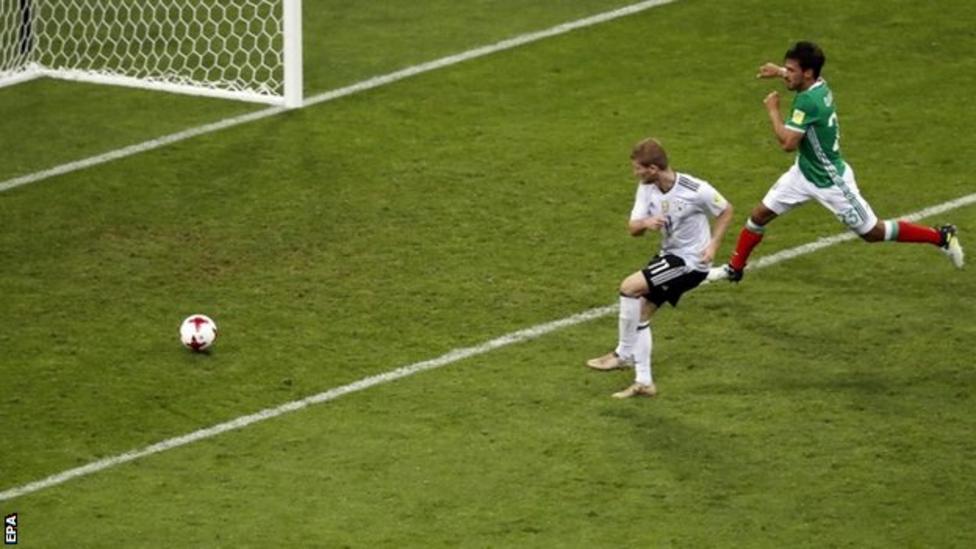
    The Schalke midfielder swept home a Benjamin Henrichs pass from 20 yards and then slotted home from Timo Werner’s through ball.

    Werner then tapped home Jonas Hector’s pass to increase Germany’s lead.

    Marco Fabian scored a brilliant 35-yard strike for Mexico, before Amin Younes added a fourth for Germany.

    Mexico had plenty of chances to come back into the game at 2-0 down but squandered them.

    Fabian’s stunner came too late to threaten a comeback, although there was a chaotic ending with several chances at both ends.

    While Germany go onto Sunday’s final in St Petersburg, Mexico face Portugal in a third-fourth play-off earlier that day.

    Timo Werner
    Timo Werner scored Germany’s third to join Leon Goretzka on three goals for the tournament

    Germany boss Joachim Low left most of his regular star players at home, including Manuel Neuer, Jerome Boateng, Mesut Ozil, Toni Kroos and Thomas Muller.

    That their weakened squad includes first-team players from Barcelona, Bayern Munich, Manchester City, Paris St-Germain, Arsenal and Liverpool speaks a lot about the strength in depth of German football.

    Germany have two young teams in international finals this weekend. Five of the starting 11 in the Confederations Cup semi-final would have been eligible for Saturday’s European Under-21 Championship final against Spain – including Goretzka and Werner, who are now joint top scorers in the tournament with three apiece.

    Despite their opponents having chances, Germany looked comfortable, with Goretzka impressive before he was replaced midway through the second half and Werner staking a claim to be Germany’s first-choice striker for next summer’s World Cup.

    The RB Leipzig front man could have scored more, but attempted to poke one effort through Guillermo Ochoa’s legs, with the Mexican keeper blocking that effort, and put another shot wide from a wide angle.

    Ajax’s Younes scored their late fourth, turning home a pass from fellow substitute Mere Can.

    Twenty six shots. One goal. Mexico waste their chances

    Mexico score
    It took Mexico 89 minutes, but they finally beat Marc-Andre ter Stegen

    With better finishing, Mexico could have revitalised a game that felt over within eight minutes. They had more than twice as many shots as Germany – 26-12 – and had more efforts on target too, eight to seven.

    Fabian’s effort from a short free-kick was the best goal of the game.

    At 2-0, Giovani dos Santos forced a save from Marc-Andre ter Stegen and Javier Hernandez shot over from six yards, while Hector Herrera and Raul Jimenez also tested the Barcelona keeper.

    Jimenez went even closer when he hit the crossbar with a header in the 75th minute, although at 3-0 that would only have been a consolation.

    After Younes made it 4-1 in injury time, Mexico still had time for more attempts with Hernandez clipping the post and Jimenez heading wide.

    Mexico start their Gold Cup defence a week after their third-fourth play-off against Portugal.

    However, only three members of the Confederations Cup squad are playing in the tournament for teams in North and Central America and the Caribbean.

  • FIFA Confederations Cup: Mexico came from behind to beat New Zealand

    FIFA Confederations Cup: Mexico came from behind to beat New Zealand

    Mexico scored twice in a busy second-half performance to overcome New Zealand 2-1 and destroy the All Whites’ dreams of securing their first Confederations Cup victory at the 11th attempt.

    New Zealand had the better of the first half on Wednesday at the Fisht Stadium in Socchi, Russia and went 1-0 up thanks to a nice goal from Chris Wood.

    But Mexico stormed back after the break and Raul Jimenez got the equaliser nine minutes into the second period of the Group A match.

    Javier Aquino dribbled in from the left and after an exchange of passes on the edge of the New Zealand box, Jimenez spun to fire high into the net.

    Mexico took control of the game and Oribe Peralta grabbed the winner from close range after 72 minutes when he swept home another incisive cross from Aquino.

    Mexico ended the day as Group A leaders with four points, ahead of Portugal on goal difference.

    Hosts Russia are in third with three points and New Zealand have none.

    In continuation of their 2017 FIFA Confederations Cup campaign, all four sides return on Saturday to see whether they will advance to the semi-finals.

    Russia will face Mexico, needing a win to be sure of progress with a draw being sufficient for their opponents, while Portugal are expected to beat New Zealand to top the group.

  • Mexico snatch draw with Portugal in confederations cup

    Mexico snatch draw with Portugal in confederations cup

    Mexico claimed a 2-2 draw with Portugal in their Confederations Cup opener on Sunday.

    A last-gasp equaliser by Hector Moreno saved the day for them after Cedric seemed to have won the game for the European champions with a goal five minutes from time.

    Portugal had an early effort controversially disallowed by the video referees but they eventually took the lead after 34 minutes through Ricardo Quaresma.

    This was after a mistake by Carlos Salcedo had let Cristiano Ronaldo through on goal.

    The Portugal captain could not control the ball to shoot but his brilliant pass between three defenders left Quaresma free to round goalkeeper Guillermo Ochoa and tap into the empty net.

    Mexico equalised eight minutes later through a Javier Hernandez diving header after poor defending by the Portuguese.

    Raphael Guerreiro miskicked a cross into the box, allowing Carlos Vela to play the ball back in for Hernandez to score.

    Portugal looked to have won when Cedric fired home a deflected shot but Moreno headed home a corner in added time to give Mexico a share of the points.

    “I think we were superior, we created more chances and we leave the field frustrated,’’ Cedric said. “We were always more dangerous than them, both in our organised play and on the counter attack.’’

    Although Mexico had more possession, Ochoa was the busier of the two goalkeepers.

    The Europeans could have taken all three points had the Video Assistant Referees (VAR) not controversially disallowed Nani’s first-half goal for offside.

    Ronaldo smacked a long-range shot onto the bar and Nani picked up the rebound to volley home.

    However, the VAR disallowed the goal for an offside infringement earlier in the move.

    The result leaves both sides tied for second place in Group A, behind hosts Russia who top the group after beating New Zealand 2-0 on Saturday in St. Petersburg.

    The News Agency of Nigeria (NAN) reports that Russia will face Portugal and Mexico take on New Zealand on Wednesday.

  • World Cup 2026: US, Canada, Mexico to make joint bid

    World Cup 2026: US, Canada, Mexico to make joint bid

    The U.S., Canada and Mexico have announced they will make a joint bid to host the 2026 World Cup finals.

    The 2026 finals will be the first tournament after the expansion from 32 teams to 48 and, if successful, would be the first time a World Cup has been shared by three hosts.

    The proposal would be for the U.S. to host 60 matches, with 10 games each in Canada and Mexico.

    The decision on who will host the event will be made in 2020.

    That is three years later than originally scheduled because of corruption allegations surrounding the awarding of the 2018 and 2022 World Cups to Russia and Qatar.

    The U.S. staged the 1994 World Cup, which had the highest average attendance in the tournament’s history.

    Mexico was the first nation to host the event twice, in 1970 and 1986, while Canada hosted the 2015 women’s World Cup.

    President Donald Trump has promised to build a border wall between the U.S. and Mexico but Sunil Gulati, president of the US Soccer Federation, said Trump is “supportive” of the bid.

    He said he had even “encouraged” it.

    “The U.S., Mexico and Canada have individually demonstrated their exceptional abilities to host world-class events,” added Gulati.

    “When our nations come together as one – as we will for 2026 – there is no question the U.S., Mexico and Canada will deliver an experience that will celebrate the game and serve players, supporters and partners alike.”

    European and Asian countries cannot bid for the 2026 World Cup due to world governing body FIFA’s rotation policy.

    It means the previous two host confederations – Europe in 2018 and Asia in 2022 – are excluded.

    The new-look tournament will begin with an initial round of 16 three-team groups, with 32 qualifiers going through to the knockout stage.


  • US, Mexico, Canada in joint bid for 2026 World Cup

    The United States, Mexico and Canada announced a joint bid to stage the 2026 World Cup on Monday, aiming to become the first three-way co-hosts in the history of FIFA’s showpiece tournament.

    The bid was announced at a press conference in New York attended by the head of CONCACAF, Victor Montagliani along with US Soccer Federation chief Sunil Gulati and Mexico counterpart Decio de Maria.

  • Facebook Messenger to add app for live location-sharing

    Facebook Messenger to add app for live location-sharing

    Facebook Inc (FB.O) will add a feature to its Messenger app on Monday to allow users to share their locations, the company said, ramping up competition with tools offered by Apple Inc (AAPL.O) and Alphabet Inc’s (GOOGL.O) Google Maps.

    The company has found that one of the most used phrases on Messenger as people talk to friends and family is “How far away are you?” or some variation, Stan Chudnovsky, head of product for Messenger, said in an interview.

    “It happens to be what people are saying, what they’re interested in the most,” he said.

    Sharing location information will be optional, he said, but it will also be live, so that once a user shares the information with a friend, the friend will be able to watch the user’s movement for up to 60 minutes.

    Messenger was once part of the core Facebook smartphone app, but the company broke it out as a separate app in 2014 and has since invested in frequent changes to build a service distinct from the massive social network.

    Google Maps said last week that it was adding a similar feature, an attempt to boost engagement on a product of increasing strategic importance to that company.

    The close proximity of the announcements tells Facebook “that we’re working on the right things,” Chudnovsky said.

    The Messages app on Apple’s iPhone has such a feature, too.

    Facebook has been testing its change in Mexico, he said.

    It was ready as long ago as October, he added, but the company worked on it for five more months to minimize the impact on the battery life of phones.


  • Trump insists Mexico will pay for border wall

    Trump insists Mexico will pay for border wall

    U.S. President-in-waiting Donald Trump has insisted that Mexico would pay for the border wall and refuted reports to the contrary.

    Trump, in a tweet on Friday, lashed out at the media for reports suggesting he was going back on a campaign vow to make Mexico pay for a border wall with the U.S.

    In an early-morning Twitter response, Trump called the reports “dishonest” and suggested the U.S. would only be putting up money for the “sake of speed” — and vowed Mexico would eventually pay it back.

    “The dishonest media does not report that any money spent on building the Great Wall (for sake of speed), will be paid back by Mexico later!” Trump tweeted.

    His tweet suggested that Mexico would reimburse American taxpayers for any money Washington spends up front.

    There are reports that Trump is considering a plan to ask Congress to ensure money is available in U.S. coffers for the wall, while relying on existing law that already authorises fencing and other technology along the southern border.

    The funding development was reportedly a reversal by Trump on his promise to stick Mexico with the bill.

    Senior adviser Kellyanne Conway confirmed on “Fox & Friends” that Trump wants Mexico to pay back any costs shouldered by the U.S. and that he was not going back on his promise.

    “He is going to build that wall, and Mexico is going to pay for it. That has not changed,” Conway insisted.

    It remains unclear how the Trump administration would compel Mexico to pay, as America’s southern neighbour has shown no intention of doing so.

    In the near-term, the push to rely on existing law authorising a border fence could stave off a legislative fight that Trump might lose if he tried to get Congress to pass a measure authorising the kind of border wall he promised during the campaign.

    Trump’s vow to build an impenetrable, concrete wall along the southern border was his signature campaign proposal.

    “Build the wall!” supporters would chant at his rallies.

    “Who’s going to pay for it?” Trump would ask them and they would respond: “Mexico!”

    Trump often promised the wall would be built of hardened concrete, rebar and steel as tall as his venues’ ceilings, and would feature a “big, beautiful door’’ to allow legal immigrants to enter.

    Most experts viewed such promises as unrealistic and impractical, and Trump himself sometimes allowed that the wall would not need to span the entire length of the border, thanks to natural barriers like rivers.

    However, after winning the election, the incoming president said he would be open to stretches of fencing.