Tag: MTN

  • CBN awaits MTN’s action on $8.1b refund order

    The Central Bank of Nigeria (CBN) is not worried by MTN’s denial of alleged illegal repatriation of $8,134,312,397.63 it levelled against the mobile giant.

    An official, who was reacting to MTN’s denial of the allegation, was asked what the CBN will do “in the event that MTN refuses to pay back the $8.1 billion and when the ‘immediate effect’ deadline given to MTN will expire?”

    The official, who refused to be named, said: “When we get to that bridge, we’ll know how to cross it.”

    To some experts, the CBN has taken a bold stand against banks and the company for alleged money laundering.

    The MTN on Thursday rejected the CBN’s claim in a statement.

    It said: “MTN Nigeria strongly refutes these allegations and claims. No dividends have been declared or paid by MTN Nigeria other than pursuant to CCIs issued by our bankers and with the approval of the CBN as required by law.

    “MTN Nigeria, as a law-abiding citizen of Nigeria, is committed to good governance and to abiding by the extant laws of the Federal Republic of Nigeria. The re-emergence of these issues is regrettable as it damages investor confidence and, by extension, inhibits the growth and development of the Nigerian economy.

    “We will engage with the relevant authorities and vigorously defend our position on this matter and provide further information when available”.

    Prof. Uche Uwaleke of Nasarawa State University told The Nation that “by sanctioning the affected banks, the CBN has demonstrated that the country’s financial markets have laws which must be complied with by all participants”.

    Uwaleke lamented the scale of alleged money laundering and illegal repatriation of foreign currency out of the country, stressing that “the scale of the infraction could not have been possible without collaborators within the Deposit Money Banks (DMBs).”

    Uwaleke, who is “the first Professor of Capital Market” in Nigeria, urged the Nigerian authorities to go “beyond the fines imposed on the banks”, adding that “it is vital that the Economic and Financial Crimes Commission (EFCC) is involved to fish out individuals or professional services firms that aided these banks to perpetrate the use of fake Certificates of Capital Importation, fraudulent conversion of investors’ loans to preference shares and rendering false returns to the CBN”.

    The implications for the economy, he said, are anything but salutary. To Uwaleke, “the illegal repatriation of forex by these banks would have contributed to the pressure on the exchange rate which negatively impacted production and the general price level.”

    According to the NBS capital importation report for Q2 2018, Standard Chartered Bank and Stanbic IBTC were responsible for the bulk of capital importation during the quarter. “This development will no doubt change this narrative at least in the near term,” Uwaleke said.

    He also cautioned that perhaps the stock market will be hit badly because two of the banks –  Stanbic IBTC and Diamond Bank  – are listed on the Stock Exchange and “the fall in their share prices could drag down the banking index as Investors are most likely to shy away from banking stocks till this issue is sorted out.”

    Uwaleke also predicted that “this development could roll back the plan by MTN to list on the Nigerian Stock Exchange”.  “Be that as it may, the sanctions carry a positive signalling effect for the economy in the long run,” he said.

    Our regulatory agencies Uwaleke said, “should continue to ensure that the Multinational companies operating in Nigeria particularly in the oil, banking and telecom sectors comply with extant laws”.

    Mr. Odilim Enwegbara, a development economist and financial expert who is the Chairman/CEO at Pan Africa Development Corporate Company (PADCC), was excited that “for the first time, I am proud of the CBN and its forex administration for identifying this huge infraction of illegally converting shareholders’ loan to preference shares (interest free loan) of $399,594,146.00″ leading to the sum $8.1 billion being illegally repatriated on behalf MTN between 2007 and 2015, which CBN‘s regulatory and supervisory departments detected.”

    Eweagbara said he was “happy to hear that not only are the banks involved in this illegal transfer accordingly fined for breaking the country’s foreign exchange law, but that MTN, which has been acting like an economic hit corporation in Nigeria is asked to return the said $8.1billion illegally repatriated out of the country.”

    Eweagbara suggested that “the CBN should also insist that besides the $8.1 billion, MTN should pay all the accumulated interest based on our prevailing interest rate”.

    He also called on the CBN to appoint a team of forensic auditors “to fully audit MTN’s books since its commencement of operation in Nigeria”. “It should include examining all the past forex repatriation out of Nigeria and processes and taxes.”

    Eweagbara said: “I will also go further to suggest that there should be Forex Repatriation law that should insist that no foreign, domestic corporation or individual should be allowed to repatriate more than $10 million out of the country without first having been approved by the President himself based on the advice of the Federal Ministry of Finance and Federal Inland Revenue Services (FIRS) with the first approval coming from the CBN.”

    “Both Ministry of Finance and Federal Inland Revenue Service should crosscheck and confirm through attached memos from the CBN, evidence that explains why the said corporation or individual has fully met all the forex repatriation laws of Nigeria. While the CBN memo will approve the source of the money, the authenticity of the overseas recipient(s), and that all international and domestic anti-money laundering laws have fully been satisfied, the FIRS memo should show that all required taxes have been duly paid.”

    The PADCC Chairman and CEO added that, ”it is high time we established the Nigerian Banking Regulation Commission, which as a spin-off from the CBN, will be fully responsible for ensuring that banking infractions are minimal, given its eagle-eye focus on the activities of banks in the country.”

    This way, he noted, “the CBN will be responsible for monetary policy making alone”. “If countries like China, US, UK, etc.have since created banking regulatory and supervisory agencies separate from their apex banks and as a result are enjoying the huge benefits, why shouldn’t Nigeria do the same in order to drastically reduce bank infractions?”

    The CBN last Wednesday imposed heavy sanctions totaling N5.87 billion on four banks under its regulatory purview and asked MTN to refund $8,134,312,397.63 for what it described as ”flagrant violation of extant laws and regulations of the Federal Republic of Nigeria, including the Foreign Exchange (Monitoring and Miscellaneous Provisions) Act, 1995 of the Federal Republic of Nigeria and the Foreign Exchange Manual, 2006″.

    The four banks are Standard Chartered Bank, Stanbic-IBTC, Citibank, and Diamond Bank.

    The actions of the CBN became necessary following allegations of remittance of foreign exchange with irregular Certificates of Capital Importation (CCIs) issued on behalf of some offshore investors of MTN Nigeria Communications Limited and subsequent investigations carried out by the apex bank in March 2018.

    The CBN  asked five banks and MTN to immediately refund $8,134,312,397.63 illegally repatriated by the company to its coffers.


  • MTN rejects CBN’s order to refund $8.1b

    FRONTLINE mobile company MTN Nigeria yesterday rejected the allegation that it repatriated $8.1 billion illegally. The Central Bank of Nigeria (CBN) asked the company to refund the cash.

    The telco insisted that all the dividends it paid to its shareholders between 2007 and 2015 were approved by the apex bank.

    The company was reacting to the claim of the apex bank that it illegally converted shareholder loans to preference share and repatriated $8.1 billion as dividends during the period under scrutiny.

    MTN, in a statement titled: Central Bank of Nigeria (CBN) correspondence regarding Certificates of Capital Importation (CCIs) in Nigeria” issued yesterday, said it strongly refutes the allegations and claims.

    “MTN Nigeria Communications Limited (MTN Nigeria) received a letter on 29 August 2018 from CBN alleging that CCIs issued in respect of the conversion of shareholders’ loans in MTN Nigeria to preference shares in 2007 had been improperly issued. As a consequence, they claim that historic dividends repatriated by MTN Nigeria between 2007 and 2015 amounting to $8.1 billion need to be refunded to the CBN.

    “MTN Nigeria strongly refutes these allegations and claims. No dividends have been declared or paid by MTN Nigeria other than pursuant to CCIs issued by our bankers and with the approval of the CBN as required by law,” the telco said.

    MTN said the issues surrounding the CCIs had been the subject of a thorough enquiry by the Senate.

    “In September 2016, the Senate mandated the Committee on Banking, Insurance and other Financial Institutions to carry out a holistic investigation on compliance with the Foreign Exchange (Monitoring and Miscellaneous) Act by MTN Nigeria & Others. In its report issued in November 2017, the findings evidenced that MTN Nigeria did not collude to contravene the foreign exchange laws and there were no negative recommendations made against MTN Nigeria.

    “MTN Nigeria, as a law-abiding citizen of Nigeria, is committed to good governance and to abiding by the extant laws of the Federal Republic of Nigeria. The re-emergence of these issues is regrettable as it damages investor confidence and, by extension, inhibits the growth and development of the Nigerian economy.

    “We will engage with the relevant authorities and vigorously defend our position on this matter and provide further information when available,” the telco said.

    In 2015, the Nigerian Communications Commission (NCC) fined MTN N1.04 trillion on the telco for failing to deactivate unregistered lines. The huge penalty was negotiated down to N330 billion out of which the Attorney-General of the Federation, Abubakar Malami (SAN), said his ministry paid N500 million to lawyers for helping with negotiations.

    The CBN, in a letter to MTN, had said its investigation  revealed that its shareholders had invested $402,590,261.03 in the company from 2001 to 2006 and that the investment was done through the inflow of foreign currency cash transfers and equipment importation, evidenced by the CCIs issued by Standard Chartered Bank (SCB), Citi Bank (CB) and Diamond Bank (DB).  It added that the CCIs issued at the time of the investment by the banks to MTN in respect of the $402,590,261.03 showed that $59,436,923.44 was invested as shareholders’ loan and $343,153,339.56 as equity.

    “However, a review of your organisation’s financial statements for the year ended December 31, 2007 revealed that $399,594,146.00 was recorded/invested as shareholders’ loan and $2,996,117.00 as equity investment, in accordance with the shareholder’s agreement but contrary to the CCIs issued by the banks.

    “Following a request by your organisation through Standard Chartered Bank for CBN’s approval to convert the shareholder’s loan to preference shares, an approval-in-principle was granted vide our letter dated November 13, 2007; with the grant of final approval made subject to the fulfillment of the following conditions by your organisation.

    “Implementation of the decision…of your board resolution dated November 08, 2007 and submission of documentary evidence to that effect to the Director, Trade and Exchange Department of the CBN; and provision of an undertaking that no remittance for either interest or principal repayment would be made to the shareholders from the date of the loan to the date they were converted to preference shares,” the apex bank said.

    In spite of the non-fulfillment of the stated conditions and consequently, the non-issuance, of a final approval, the CBN said MTN converted the shareholders’ loan to preference shares with Standard Charted Bank issuing new CCIs in respect of the illegal conversion.

    “The action of your banker in aiding your organisation in the illegal conversion of the shareholders’ loan was later described by SCB in a letter to the CBN dated December 10, 2009 as an “unintended omission”.

    “On account of the illegal conversion of your shareholders’ loan to preference shares (interest free loan) of $399,594,146.00, the sum of $8,134,312,397.63 was illegally repatriated on behalf of your company by the aforementioned banks between 2007 and 2015,” the CBN alleged.

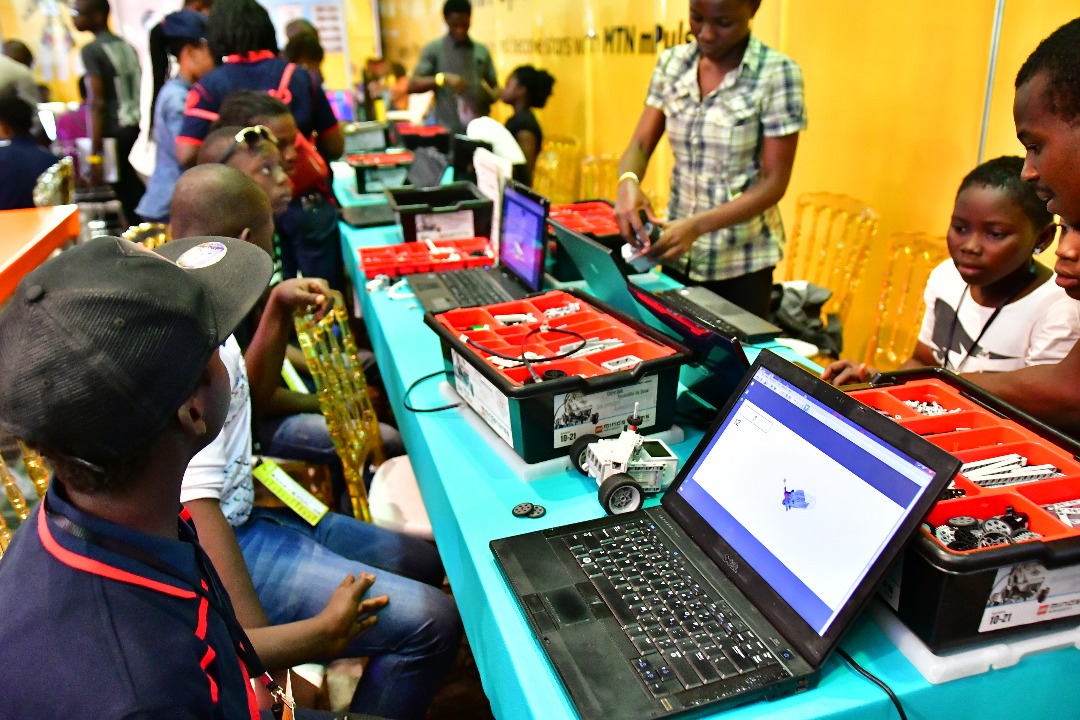
  • Tecno partners MTN on mPulse

    TECNO mobile has partnered MTN to launch mPulse, a unique initiative to channel the work ethic of teenagers and create a subconscious template of optimal productivity which would be beneficial to themselves and their environment.

    The specially-designed platform is for youngsters from nine to 15, to enable them learn and gain pragmatic skills while also having fun.

    The unveiling, which held at the Landmark Event Centre, Victoria Island, Lagos, was lit up with attractions that included a Virtual Reality Master Class facilitated by Obaloluwa Odelana, a 13-year-old JSS3 pupil, and the youngest African hyper-realism artist, Kareem Waris Olamilekan of Waspa Art, who inspired children at the event through their craft which had recently gained massive recognition through social media.

    As proud partners of the event, Tecno’s recently released Spark 2 was showcased as the kids trooped to the Tecno experiential booth to have a first-hand feel of the device which comprises features such as a 6.0 HD+ screen, 13MP rear camera, 3500mAh battery and so much more.

    The mPulse package comes with a voice plan and a fun, educative website which hosts various courses and study aids to help children from Primary one to SS3 excel.

    The portal also provides a bouquet of single and multiplayer games, as well as life skill videos, from computer programming, fashion designing, medicine and blogging to engineering, writing, data science and motivational speaking.

  • Illegal repatriation of $8.1b: MTN denies CBN claims

    MTN Nigeria on Thursday refuted the claims by the Central Bank of Nigeria that it illegally, in collusion with four Nigerian banks repatriated $8.1billion from its Nigerian operations to offshore investors.

    The CBN said the remittances between 2007 and 2015, in tranches of of 2.63 billion dollars, 1.766 billion dollars and 348 million dollars were done in flagrant violation of the rule that says it can only be done with regular ‘Certificates of Capital Importation (CCIs)’ issued by the apex bank.

    The CBN said MTN did the repatriation after illegally converting shareholders’ loan of $399, 594,146 to preference shares.

    As part of the sanctions, four banks, Stanbic IBTC Nigeria, Citibank Nigeria and Diamond Bank Plc, were fined by the CBN.

    Standard Chartered Bank would pay a fine of N2.47 billion, Stanbic IBTC, N1.88 billion, Citibank Nigeria, N1.26 billion and Diamond bank, N250 million.

    Mr Funso Aina, Public Relations Manager, Corporate Affairs/Corporate Relations MTN denied the claims by the CBN

    “MTN Nigeria received a letter on Aug 29 from Central Bank of Nigeria (CBN) alleging that Certificate of Capital Important (CCIs) issued in respect of the conversion of shareholders’ loans in MTN Nigeria to preference shares in 2007 had been improperly issued.

    `As a consequence they claim that historic dividends repatriated by MTN Nigeria between 2007 and 2015 amounting to $8.1 billion need to be refunded to the CBN.

    “MTN Nigeria strongly refutes these allegations and claims.

    Read Also: CBN fines four banks N5.8bn over MTN ’s transaction

    “No dividends have been declared or paid by MTN Nigeria other than pursuant to CCIs issued by our bankers and with the approval of the CBN as required by law,” he said.

    Aina said that the issues surrounding the CCIs had already been the subject of a thorough enquiry by the Senate of Nigeria.

    He added that in September 2016 the Senate mandated the Committee on Banking, Insurance and other Financial Institutions to carry out a holistic investigation on compliance with the Foreign exchange (monitoring and miscellaneous) Act by MTN Nigeria & Others.

    He said that in its report issued in November 2017, the findings evidenced that MTN Nigeria did not collude to contravene the foreign exchange laws and there were no negative recommendations made against MTN Nigeria.

    “MTN Nigeria, as a law-abiding citizen of Nigeria, is committed to good governance and to abide by the extant laws of the Federal Republic of Nigeria.

    “The re-emergence of these issues is regrettable as it damages investor confidence and, by extension, inhibits the growth and development of the Nigerian economy.

    “We will engage with the relevant authorities and vigorously defend our position on this matter and provide further information when available.

    CBN’s spokesperson, Isaac Okorafor, said the apex bank has written MTN Nigeria demanding a refund of the $8.13 billion, repatriated.

    The Bank resolved to sanction the commercial banks following investigations in March 2018, which confirmed allegations of remittance of foreign exchange with irregular Certificates of Capital Importation (CCIs) issued on behalf of some offshore investors of MTN Nigeria.

  • MTN to refund $8b as CBN fines four banks N5.87b

    Standard Chartered to pay N2.4b
    Stanbic IBTC N1.8b
    Citibank N1.2b Diamond Bank N0.25b

    MOBILE giant MTN Nigeria is to refund $8,134,312, 397.63 it illegally repatriated to the Central Bank of Nigeria (CBN), the apex bank said yesterday.

    The CBN said it had imposed N5.87 billion sanctions on four banks, which are to refund $8,134,312, 397.63 for “flagrant violation of extant laws and regulations of Nigeria, including the Foreign Exchange (Monitoring and Miscellaneous Provisions) Act, 1995 of the Federal Republic of Nigeria and the Foreign Exchange Manual, 2006”.

    So far, the telco has paid N165 billion out of N330 billion fine, representing 60 per cent of total payment, according to the CEO of NCC, Prof Umar Danbatta.

    CBN’s Director, Corporate Communications, Isaac Okorafor, in a statement in Abuja, said the actions of the apex bank became necessary following allegations of remittance of foreign exchange (forex) with irregular Certificates of Capital Importation (CCIs) issued on behalf of some offshore investors of MTN Nigeria Communications Limited and subsequent investigations carried out by the apex bank in March this year.

    The four lenders also came under the sledge hammer of the CBN for violations of extant forex regulations. The lenders are Standard Chartered Bank, Stanbic-IBTC, Citibank, and Diamond Bank.

    Figures obtained from the CBN yesterday indicate that the highest fine of N2,470,604,767.13 was slammed on Standard Chartered Bank. Stanbic IBTC Nigeria was fined N1,885,852,847.45. Citibank Nigeria was penalised N1,265,541,562.31. Diamond Bank was directed to pay N250 million.

    Okoroafor said the decision followed thorough investigations into the allegations of remittances by the four banks of forex with irregular certificates of CCIs issued on behalf of some offshore investors of MTN Nigeria Communications Limited.

    He said $3,448,119,321.72 was repatriated by Standard Chartered Bank on the basis of the illegally issued CCIs. Similarly, $2,632,005,623.78, $1,766,263,212.75 and $348,914,501.30 were repatriated by Stanbic IBTC Nigeria, Citibank Nigeria and Diamond Bank Plc between 2007 and 2015. The CBN directed the banks to immediately refund the sums.

    The apex bank’s investigation revealed that on account of illegal conversion of MTN shareholders’ loan to preference shares (interest free loan) of $399,594,146.00, $8,134,312,397.63 was illegally repatriated by the telco.

    Okoroafor  said investigations by the CBN took a while in order to carry out a thorough inquiry and give fair hearing to all parties involved. He advised all banks and multinational companies to adhere strictly to the provisions of all extant laws and regulations in their forex transactions. He warned that failure by the management of banks and companies to abide by existing guidelines would be appropriately sanctioned. Sanctions may include denial of access to local forex market.

    About two years ago, the telco was accused of illegally repatriating $13.8 billion. It blamed its failure to comply with the law requiring issuance of CCIs within 24 hours of conversion on “administrative requirement”.

    During the opening of investigative hearing by the Senate Committee on Banks, Insurance and Other Financial Institutions into the transfer, MTN said circumstances beyond its control necessitated its decision to move funds without following the law.

    A lawmaker had accused MTN of flouting its host country’s financial regulatory laws to obtain a CCI within 24 hours before moving the money out of the country without the required authorisation.

    The repatriation was allegedly carried out between 2006 and 2016 in connivance with the Minister of Trade and Investment, Okechukwu Enelamah, and four commercial banks – Standard Chartered Bank, Stanbic IBTC, Diamond Bank and Citi Bank.

    The CCI is a requirement under the Central Bank of Nigeria (CBN) financial and miscellaneous provisions Act.

    The telco’s Chief Executive Officer (CEO), Ferdi Moolman, had said it was practically impossible for the firm to comply with the 24 hours required to issue the CCI before moving funds.

    “The requirement to issue a CCI within 24 hours of conversion is an administrative requirement. As such, the CBN has the authority, and indeed we believe approved the banks’ applications to issue CCIs outside the recommended time frame.

    “Often, for various reasons (such as not having all the required documentation for instance), it is not possible to issue a CCI within 24 hours, and the Central Bank of Nigeria’s Forex Manual contemplates such situations by asking that the banks refer to the CBN for approval,” Mr. Moolman had explained in a statement from Johannesburg, South Africa.

    He said no dividends were declared or paid until the CCIs were issued and finalised, adding that MTN Nigeria only requested CCIs for Foreign Capital that was imported into Nigeria, and dividends were externalised on CCIs.

    MTN Nigeria

    CBN’s letter to MTN reads: “Our investigation also revealed the following, among others: that the shareholders of your company invested the sum of $402,590,261.03 in the company from 2001 to 2006; The investment was carried out through the inflow of foreign currency cash transfers and equipment importation, which was evidenced by the CCIs issued by Standard Chartered Bank (SCB), Citi Bank (CB) and Diamond Bank (DB);  and the CCIs issued at the time of the investment by the above banks to your organisation in respect of the $402,590,261.03 showed that $59,436,923.44 was invested as shareholders’ loan and $343,153,339.56 as equity.

    “However, a review of your organisation’s financial statements for the year ended December 31, 2007 revealed that $399,594,146.00 was recorded/invested as shareholders’ loan and $2,996,117.00 as equity investment, in accordance with the shareholder’s agreement but contrary to the CCIs issued by the banks in (iii) above;

    “Following a request by your organisation through Standard Chartered Bank for CBN’s approval to convert the shareholder’s loan to preference shares, an approval-in-principle was granted vide our letter dated November 13, 2007; with the grant of final approval made subject to the fulfillment of the following conditions by your organisation.

    “Implementation of the decision in item 5B of your board resolution dated November 08, 2007 and submission of documentary evidence to that effect to the Director, Trade and Exchange Department of the CBN; and

    “Provision of an undertaking that no remittance for either interest or principal repayment would be made to the shareholders from the date of the loan to the date they were converted to preference shares.

    “In spite of the non-fulfillment of the conditions in (v) above and consequently, the non-issuance of a final approval by the CBN, your organisation converted the shareholders’ loan to preference shares with Standard Chartered Bank issuing new CCIs in respect of the illegal conversion;

    “The action of your banker in aiding your organisation in the illegal conversion of the shareholders’ loan was later described by SCB in a letter to the CBN dated December 10, 2009 as an “unintended omission”; and

    “On account of the illegal conversion of your shareholders’ loan to preference shares (interest free loan) of $399,594,146.00, the sum of $8,134,312,397.63 was illegally repatriated on behalf of your company by the aforementioned banks between 2007 and 2015.”

    Standard Chartered

    In a letter to Standard Chartered, the apex bank said that its investigation also revealed that shareholders of MTN Nigeria Communications Limited invested $402,590,261.03 in the company from 2001 to 2006; the investment was carried out through the inflow of foreign currency cash transfers and equipment importation, which was evidenced by the CCIs issued by your bank, Citi Bank (CB) and Diamond Bank (DB) at the initial stage of the investment; the CCIs issued at the time of investment by your bank along with the other banks in respect of the $402,590,261.03 showed that $59,436,923.44 was recorded/invested as shareholders’ loan and $343,153,339.56 as equity. “This position was, however, contrary to the position in the financial statements of MTN Nigeria Communications Limited for the year ended December 31, 2007, which revealed that $399,594,146.00 was invested as shareholders’ loan and $2,996,117.00 as equity investment, in accordance with the shareholder’s agreement but contrary to the CCIs issued by your bank, Citi Bank (CB) and Diamond Bank (DB). Your action in this regard constituted a rendition of false returns to the Central Bank of Nigeria.

    “Your bank subsequently applied to the CBN on behalf of MTN Nigeria Communications Limited for the conversion of the shareholder’s loan to preference shares, for which an approval-in-principle was granted vide our letter dated November 13, 2007 with the grant of final approval made subject to the fulfillment of the following conditions by MTNN:

    “Implementation of the decision in item 5B of MTN Nigeria Communications Limited board resolution dated November 8, 2007 and submission of documentary evidence to that effect to the Director, Trade and Exchange Department of the Central Bank of Nigeria; and provision of an undertaking that no remittance for either interest or principal repayment would be made to the shareholders from the date of the loan to the date they were converted to preference shares.

    “In spite of the non-fulfillment of the above conditions in (iv) above and consequently, the non-issuance of a final approval by the CBN, your bank issued new CCIs in support of the illegal conversion of the shareholders’ loan to preference shares; an action that was later described by your bank in a letter to the CBN dated December 10, 2009, as an “unintended omission”; and on account of the illegal conversion of the shareholders loan to preference shares (interest free loan) of $399,594,146.00, the sum of $8,134,312,397.63 was illegally repatriated by your bank and the other banks on behalf of MTN Nigeria Communications Limited between 2007 and 2015,” the apex bank said.

    Other findings from its investigation showed that bank issued three  CCIs outside the regulatory 24 hours without the approval of the CBN; in contravention of Memorandum 24 of the Foreign Exchange Manual, which requires that CCIs should be transferred based on customer’s instructions to a bank of the customer’s choice along with the transaction history of the CCI, you provided confirmation to two other banks, Citibank and Diamond Bank, instead of transferring the CCIs to them as required by the Foreign Exchange Manual.

    “The two banks on the strength of your confirmation subsequently remitted various sums as dividend for MTN Nigeria Communications Limited at different times; and

    ‘Your bank failed to issue a letter of indemnity to the CBN against double remittance in respect of ten CCIs transferred by Diamond Bank and Citibank to your bank as required under subsection 5(iii) of Memorandum 24 of the Foreign Exchange Manual.

    “Upon the conclusion of the investigation, the Committee of Governors of the Central Bank of Nigeria met with the management of your bank and the other banks as well as representatives of MTN Nigeria Communications Limited in Lagos on May 25, 2018. This was to give all the parties fair hearing, towards taking an informed decision on the matter,” the apex said.

    Stanbic IBTC

    On Stanbic-IBTC, the CBN said its investigation also revealed that the shareholders of MTN Nigeria Communications Limited invested $402,590,261.03 in the company from 2001 to 2006. The investment was carried out through the inflow of foreign currency cash transfers and equipment importation, which was evidenced by the CCIs issued by Standard Chartered Bank, Diamond Bank and Citibank, out of which eight of the CCIs totaling $377,216,508.30 were transferred to your bank by Standard Chartered Bank.  Consequently, your bank repatriated the sum of $929,051,331.83 as proceeds of divestment from the CCIs valued at $42,704,408.61.”

    On account of the illegal conversion of the shareholders loan to preference shares (interest free loan) of $399,594,146.00, $8,134,312,397.63 was illegally repatriated by your bank and the other banks on behalf of MTN Nigeria Communications Limited between 2007 and 2015.”

    Other findings from the investigation also showed that  the bank falsely reported 35 CCIs valued $313,683,925.84 inappropriately as “other purchases” in your MTR 203 returns for February 2008 instead of “capital importation”;

    “Your bank issued eight CCIs of $58,359,616.67 in respect of foreign exchange sourced locally as shareholders’ loan. This constituted a contravention of the requirement of Section 15 of the Foreign Exchange (Monitoring and Miscellaneous Provisions) Act, 1995 and Memorandum 20 (1.3) (iii) of the Foreign Exchange Manual, which stipulates that CCIs should only be issued on capital imported;

    “Your bank issued eight CCIs for capital inflows in form of machinery outside the 24 hours regulatory requirement of receipt of shipping documents in contravention of paragraph 4.1.1 (IV) of the Monetary, Credit, Foreign Trade, and Exchange Policy Guidelines for Fiscal Years 2012 to 2013;

    “Your bank failed to issue a letter of indemnity to the CBN against double remittance in respect of twenty CCIs transferred by Standard Chartered Bank to your bank as required under subsection 5(iii) of Memorandum 24 of the Foreign Exchange Manual; and

    “Your bank repatriated dividends totaling $905,260.20 in respect of CCIs illegally issued on the strength of locally sourced capital.

    “Upon the conclusion of the investigation, the Committee of Governors of the Central Bank of Nigeria met with the management of your bank and the other banks as well as representatives of MTN Nigeria Communications Limited in Lagos on May 25, 2018. This was to give all the parties fair hearing, towards taking an informed decision on the matter,” the letter read.

    On its findings in its letter to CitiBank, the CBN said its investigation also revealed that the shareholders of MTN Nigeria Communications Limited invested $402,590,261.03 in the company from 2001 to 2006;           the investment was carried out through the inflow of foreign currency cash transfer and equipment importation evidenced by the CCIs issued by your bank, Standard Chartered Bank and Diamond Bank;

    The CCIs issued by your bank along with the other banks in respect of the $402,590,261.03 showed that $59,436,923.44 was recorded/invested as shareholders’ loan and $343,153,339.56 as equity at the time of the investment. This position was, however, contrary to the position in the financial statements of MTN Nigeria Communications Limited for the year ended December 31, 2007, which showed that $399,594,146.00 was invested as shareholders’ loan and $2,996,117.00 as equity investment, in accordance with the shareholder’s agreement but contrary to the CCIs issued by your bank, Standard Chartered Bank (SCB) and Diamond Bank (DB). Your action in this regard constituted a rendition of false returns to the Central Bank of Nigeria;

    “Your bank issued seven (7) CCIs to MTN Nigeria (MTNN) totaling $42,126,803.04 that were subsequently transferred to Standard Chartered Bank Limited at the request of your customer (MTNN) on February 6, 2006, which constituted part of the CCIs that were consequently irregularly re-issued;

    “Four of the CCIs issued by your bank evidencing the inflow of capital imported as cash were issued outside the period of 24 hours allowed by regulation upon the receipt of inflow, in flagrant contravention of Memorandum 22 of the Foreign Exchange Manual;

    “Your bank failed to comply with extant regulations on the issuance of letter of indemnity to the CBN in addition to forwarding the transaction history of the CCIs to the CBN, as provided in Memorandum 24(5)(ii)(b) of the Foreign Exchange Manual in respect of the CCIs received by your bank from Standard Chartered Bank; and

    “Your bank purchased $535,000,000 on the basis of photocopies of Form “A” bearing the name of Standard Chartered Bank as the applicant bank and the referenced CCIs in contravention of Memorandum 24 (4) (a) of the Foreign Exchange Manual 2006.

    “Upon the conclusion of the investigation, the Committee of Governors of the Central Bank of Nigeria met with the management of your bank and the other banks as well as representatives of MTN Nigeria Communications Limited in Lagos on May 25, 2018. This was to give all the parties fair hearing, towards taking an informed decision on the matters,” the letter read.

    CBN’s letter to Diamond Bank stated that its investigation also revealed that the shareholders of MTN Nigeria Communications Limited invested $402,590,261.03 in the company from 2011 to 2006; .

    “The investment was carried out through the inflow of foreign currency cash transfer and equipment importation, which was evidenced by the CCIs issued by your bank, Citi Bank and Standard Chartered Bank; the CCIs issued illegally by your bank along with the other banks in respect of the $402,590,261.03 showed that $59,436,923.44 was recorded/invested as shareholders’ loan and $343,153,339.56 as equity. This position was, however, contrary to the position in the financial statements of MTN Nigeria Communications Limited for the year ended December 31, 2007, which showed that $399,594,146.00 was invested as shareholders’ loan and $2,996,117.00 as equity investment, in accordance with the shareholder’s agreement but contrary to the CCIs issued by your bank, Citi Bank (CB) and Standard Chartered Bank (SCB). Your action in this regard constituted a rendition of false returns to the Central Bank of Nigeria.”


    ; and

    “On account of the illegal conversion of the shareholders loan to preference shares (interest free loan) of $399,594,146.00, the sum of $8,134,312,397.63 was illegally repatriated by your bank and the other banks on behalf of MTN Nigeria Communications Limited, within a period of six years,” the apex bank said, adding that its findings showed that the bank issued three CCIs in favour of Dantata Investment for the sum of $5million without converting the foreign exchange received into Naira as required by our regulations.  “On the basis of these illegally issued CCIs, your bank repatriated the sum of $102,545,336.77 in respect of these CCIs.”

    “A further review of the CCIs also showed that no Form “M” was opened as evidence of the utilisation of the FX for the importation of goods (as “Not valid for FX”) into the country;

    “Your bank remitted the sum of $348,914,501.38 as dividend to MTN Nigeria Communications Limited offshore corporate shareholders without any documentary evidence of the audited account of the company to justify the basis of the payment of the dividend declared and paid by MTNN. This action was a violation of the provision of Memorandum 24(4)(b) of the Foreign Exchange Manual;

    “Your bank failed to indemnify SCB for losses and/or liabilities that may arise from the use of the CCIs you transferred to SCB in violation of the provisions of the Foreign Exchange Manual 2006;

    “Your bank issued three CCIs outside the regulatory 24 hours without the approval of the CBN contrary to provisions of Memorandum 22 of the Foreign Exchange Manual 2006; and

    “Your bank illegally remitted the sum of $352,222,358.39 on behalf of Standard Chartered Bank and Stanbic IBTC Bank in respect of the various CCIs issued to MTN Nigeria Communications Limited.

    Upon the conclusion of the investigation, the Committee of Governors of the Central Bank of Nigeria met with the management of your bank and the other banks as well as representatives of MTN Nigeria Communications Limited in Lagos on May 25, 2018. This was to give all the parties fair hearing, towards taking an informed decision on the matte,” the letter explained.


  • CBN fines four banks N5.8bn over MTN’s transaction

    .Standard Chartered      N2.4b
    .Stanbic IBTC                        N1.8b
    .Citibank                                N1.2b
    .Diamond Bank                  N250m
    writes MTN to refund $8b

    The Central Bank of Nigeria ( CBN ) on Wednesday fined four banks N5.87b for violation of its capital importation policy.

    The apex bank said the affected lenders were asked to refund $8,134,312,397.63 for what it described as ‘flagrant violation of extant laws and regulations of the country, including the Foreign Exchange (Monitoring and Miscellaneous Provisions) Act, 1995 of the Federal Republic of Nigeria and the Foreign Exchange Manual, 2006’.

    A certificate of capital importation (“CCI”) is a certificate issued by a Nigerian bank confirming an inflow of foreign capital either in the form of cash (loan or equity) or goods. A CCI is usually issued in the name of the investor within 24- 48 hours of the inflow of the capital into Nigeria in line with CBN’s guidlines.

    The four banks that have come under the sledge hammer of the CBN for the violations are Standard Chartered Bank, Stanbic-IBTC, Citibank, and Diamond Bank.

    Announcing the decision in Abuja , CBN’s Director, Corporate Communications, Isaac Okorafor, said the actions of the bank became necessary following allegations of remittance of foreign exchange with irregular Certificates of Capital Importation (CCIs) issued on behalf of some offshore investors of MTN Nigeria Communications Limited and subsequent investigations carried out by the apex bank in March 2018.

    The CBN has therefore asked the managements of the banks and MTN Nigeria Communications Limited to immediately refund the sum of $8,134,312,397.63, illegally repatriated by the company to the coffers of the Central Bank of Nigeria.

    Figures obtained from the CBN indicated that the highest fine of N2,470,604,767.13 was slammed on Standard Chartered Bank, while Stanbic IBTC Nigeria was fined the sum of N1,885,852,847.45. For its punishment, Citibank Nigeria was penalized in the sum of N1,265,541,562.31, just as Diamond Bank was directed to pay the sum of N250 million for violating extant rules.

    Okorafor further disclosed that the decision of the bank followed thorough investigations by it into the allegations of remittances by the four banks of forex with irregular certificates of Capital Importation (CCIs) issued on behalf of some offshore investors of MTN Nigeria Communications Limited.

    He said the investigations revealed that the sum of $3,448,119,321.72 was repatriated by Standard Chartered Bank on the basis of the illegally issued CCIs. Similarly, he said the sums of $2,632,005,623.78, $1,766,263,212.75 and $348,914,501.30 were repatriated by Stanbic IBTC Nigeria, Citibank Nigeria and Diamond Bank Plc, respectively during the period 2007 and 2015. Accordingly, he said the CBN had directed the affected banks to immediately refund the respective sums to the CBN.

    The CBN investigation further revealed that on account of illegal conversion of MTN shareholders’ loan to preference shares (interest free loan) of $399,594,146.00, the sum of $8,134,312,397.63 was illegally repatriated by the company.

    While disclosing that the investigations by the CBN took a while in order to carry out thorough inquiry and give fair hearing to all parties involved, Okorafor advised all banks and multinational companies in Nigeria to adhere strictly to the provisions of all extant laws and regulations of Nigeria in their foreign exchange transactions. He warned that failure by the management of banks and companies to abide by the existing guidelines would be appropriately sanctioned, which sanctions may include denial of access to the Nigerian foreign exchange market.

    In a letter by the CBN to MTN, the financial sector regulator told the telecom giant that its investigation also revealed that shareholders of the company invested t $402,590,261.03 in the company from 2001 to 2006. The investment was carried out through the inflow of foreign currency cash transfers and equipment importation, which was evidenced by the CCIs issued by Standard Chartered Bank (SCB), Citi Bank (CB) and Diamond Bank (DB) and that the CCIs issued at the time of the investment by the above banks to your organization in respect of the $402,590,261.03 showed that $59,436,923.44 was invested as shareholders’ loan and $343,153,339.56 as equity.

    “However, a review of your organization’s financial statements for the year ended December 31, 2007 revealed that $399,594,146.00 was recorded/invested as shareholders’ loan and $2,996,117.00 as equity investment, in accordance with the shareholder’s agreement but contrary to the CCIs issued by the banks,” it said.

    “Following a request by your organization through Standard Chartered Bank for CBN’s approval to convert the shareholder’s loan to preference shares, an approval-in-principle was granted vide our letter dated November 13, 2007; with the grant of final approval made subject to the fulfillment of the following conditions by your organization.”

    It said MTN’s implementation of the decision in item 5B of its board resolution dated November 08, 2007 and submission of documentary evidence to that effect to the Director, Trade and Exchange Department of the Central Bank of Nigeria; and provision of an undertaking that no remittance for either interest or principal repayment would be made to the shareholders from the date of the loan to the date they were converted to preference shares.

    In spite of the non-fulfillment of the above conditions, and consequently, the non-issuance of a final approval by the CBN, the apex bank claimed that MTN converted the shareholders’ loan to preference shares with Standard Charted Bank issuing new CCIs in respect of the illegal conversion.

    Also, the action of its banker in aiding your organisation in the illegal conversion of the shareholders’ loan was later described by SCB in a letter to the CBN dated December 10, 2009 as an “unintended omission”; and        On account of the illegal conversion of your shareholders’ loan to preference shares (interest free loan) of $399,594,146.00, the sum of $8,134,312,397.63 was illegally repatriated on behalf of your company by the aforementioned banks between 2007 and 2015.

    CBN’s Letter to Standard Chartered bank claimed that the shareholders of MTN Nigeria Communications Limited invested the sum of $402,590,261.03 in the company from 2001 to 2006; and that the investment was carried out through the inflow of foreign currency cash transfers and equipment importation, which was evidenced by the CCIs issued by your bank, Citi Bank (CB) and Diamond Bank (DB) at the initial stage of the investment.

    “The CCIs issued at the time of investment by your bank along with the other banks in respect of the $402,590,261.03 showed that $59,436,923.44 was recorded/invested as shareholders’ loan and $343,153,339.56 as equity. This position was, however, contrary to the position in the financial statements of MTN Nigeria Communications Limited for the year ended December 31, 2007, which revealed that $399,594,146.00 was invested as shareholders’ loan and $2,996,117.00 as equity investment, in accordance with the shareholder’s agreement but contrary to the CCIs issued by your bank, Citi Bank (CB) and Diamond Bank (DB). Your action in this regard constituted a rendition of false returns to the Central Bank of Nigeria”.

    CBN’s letter to Stanbic-IBTC said the shareholders of MTN Nigeria Communications Limited invested the sum of $402,590,261.03 in the company from 2001 to 2006. The investment was carried out through the inflow of foreign currency cash transfers and equipment importation, which was evidenced by the CCIs issued by Standard Chartered Bank, Diamond Bank and Citibank, out of which eight of the CCIs totaling $377,216,508.30 were transferred to your bank by Standard Chartered Bank.  Consequently, your bank repatriated the sum of $929,051,331.83 as proceeds of divestment from the CCIs valued at $42,704,408.61.

    “On account of the illegal conversion of the shareholders loan to preference shares (interest free loan) of $399,594,146.00, the sum of $8,134,312,397.63 was illegally repatriated by your bank and the other banks on behalf of MTN Nigeria Communications Limited between 2007 and 2015. Your bank falsely reported thirty five CCIs valued $313,683,925.84 inappropriately as “other purchases” in your MTR 203 returns for February 2008 instead of “capital importation,” it said.

    CBN’s letter to CitiBank said the shareholders of MTN Nigeria Communications Limited invested the sum of $402,590,261.03 in the company from 2001 to 2006. The investment was carried out through the inflow of foreign currency cash transfer and equipment importation evidenced by the CCIs issued by your bank, Standard Chartered Bank and Diamond Bank.

    CBN’s letter to Diamond Bank said the shareholders of MTN Nigeria Communications Limited invested the sum of $402,590,261.03 in the company from 2011 to 2006. The investment was carried out through the inflow of foreign currency cash transfer and equipment importation, which was evidenced by the CCIs issued by your bank, Citi Bank and Standard Chartered Bank.

    Other findings from our investigation included that Diamond Bank issued three CCIs in favour of Dantata Investment for the sum of $5 million without converting the foreign exchange received into Naira as required by our regulations.  On the basis of these illegally issued CCIs, your bank repatriated the sum of $102,545,336.77 in respect of these CCIs. A further review of the CCIs also showed that no Form “M” was opened as evidence of the utilization of the FX for the importation of goods (as “Not valid for FX”) into the country.

    Diamond Bank was also accused of remitting the sum of $348,914,501.38 as dividend to MTN Nigeria Communications Limited offshore corporate shareholders without any documentary evidence of the audited account of the company to justify the basis of the payment of the dividend declared and paid by MTNN. This action was a violation of the provision of Memorandum 24(4)(b) of the Foreign Exchange Manual.

    The bank also failed to indemnify SCB for losses and/or liabilities that may arise from the use of the CCIs you transferred to SCB in violation of the provisions of the Foreign Exchange Manual 2006 among other violations.

    “Your bank illegally remitted the sum of $352,222,358.39 on behalf of Standard Chartered Bank and Stanbic IBTC Bank in respect of the various CCIs issued to MTN Nigeria Communications Limited.        Upon the conclusion of the investigation, the Committee of Governors of the Central Bank of Nigeria met with the management of your bank and the other banks as well as representatives of MTN Nigeria Communications Limited in Lagos on May 25, 2018. This was to give all the parties fair hearing, towards taking an informed decision on the matter,” it said.


  • ‘MTN ’ll breach pact if it doesn’t list on Stock Exchange’

    In 2015, the Nigerian Communications Commission (NCC) fined telecom giant MTN N1.04trillion on MTN Nigeria. The fine was reduced to N330 billion, which the firm must pay up next year. Part of the terms of settlement is the listing of MTN’s shares on the Nigeria Stock Exchange (NSE). NCC’s Executive Vice Chairman/CEO Prof Garba Umar Dambatta says the telco will be breaching the agreement if it fails to list on the Exchange. He speaks on other challenges facing the industry with ICT Editors in Abuja. LUCAS AJANAKU was there.

    You are three years in the saddle; how would you assess broadband penetration in the country?

    On assumption of office in 2015, we unveiled the eight-point agenda for the telecoms industry, among which is the broadband plan. We are keen on driving broadband penetration in the country. Before we came on board in 2015, there was a Presidential Broadband Committee set up by the Federal Government and the committee was jointly chaired by the former Executive Vice Chairman of the Commission, Dr. Earnest Ndukwe and Zenith Bank Chairman, Mr. Jim Ovia. The committee did a good job in coming up with a detailed five-year National Broadband Plan (NBP) from 2013-2018. On page nine of the NBP, it was stated that broadband penetration, as at 2012, was between four and six per cent and there were measures through which broadband penetration could be achieved. Achievement of broadband penetration is not the responsibility of NCC alone, but a combined responsibility of other agencies such as the National Information Technology Development Agency (NITDA), NigComSat, Galaxy Backbone, including critical stakeholders such as telecoms operators. They were all assigned roles in order to achieve faster broadband penetration

    So, where are we?

    The NBP stated that the country must achieve five-fold in broadband penetration, but this of course, depends on the minimum and maximum threshold. By multiplying four per cent minimum level of broadband by five, which represents the five years broadband plan, it will give 20 per cent minimum broadband target and by multiplying six per cent maximum broadband penetration as at 2012 by the five years broadband plan, it will give 30 per cent broadband penetration, which is maximum target at the end of 2018.

    But Nigeria had surpassed the minimum target of 20 per cent last year; working towards achieving the maximum target of 30 per cent by the end of 2018, according to the NBP. As of today, Nigeria has achieved 22 per cent broadband penetration, and it is close to achieving the 30 per cent target. The achievement in broadband penetration gave rise to the first phase licencsing of Infrastructure Companies (InfraCos) to drive broadband infrastructure deployment that will enable broadband penetration. The licence was planned to cover the six geopolitical zones of the country, as well as Lagos that was mapped out as a zone for the purpose. MainOne was licensed to cover Lagos zone, iConnect, a subsidiary of HIS, was granted licence to cover the Northcentral zone. These two zones were licensed before I came on board as NCC’s EVC, and it was during my tenure that we licensed additional five zones. They include Northwest, Northeast, Southwest, Southeast and Southsouth. The beauty of the licence is that it is cheap because the NCC is not keen at making so much money in the  licences.

    The NBP specified the roles of government agencies in achieving 30 per cent broadband penetrations by this year’s end.  Are we anywhere near this target?

    Yes, all government agencies that are drafted to drive the broadband policy were given specific roles but I cannot speak for them on the extent to which they have accomplished their roles. However, I know that they are all party to the implementation of the broadband policy. NITDA, for instance, has the responsibility to drive capacity building, but NCC is the arrowhead among all other government agencies in driving broadband penetration and we have done so well to achieve over 70 out of the total 30 per cent maximum broadband target for Nigeria.

    Are there challenges on the way of achieving this milestone?

    Yes, there are national and regional challenges to broadband penetration. In these two broad areas of challenges, there are backbone infrastructure challenges as well as challenges of broadband access in underserved and unserved areas of the country. In the area of access, we have about 200 access gaps but through the efforts of the NCC, we have been able to reduce them to about 190 as of today. Nigerians living within the current 190 access gap areas are not experiencing telecoms services and this is a challenge we need to address as a country. To address the challenges, there is need for capacity building to leverage ICT to do greater things and in better ways. So, we need to sensitise the people and empower them with ICT tools that will make them achieve their dreams. NCC for instance, is pioneering the Advanced Digital Acquisition Programme (ADAP) for tertiary institutions, where we have the highest concentration of talented youths. By the time they acquire the skills, they will be able to develop ICT applications. NITDA is also involved in ICT training and skills acquisition through its sponsored scholarship programmes for students studying ICT related courses, up to doctorate level.

    What is NCC doing about  interconnectivity which remains a teething problem?

    The advisory committee set up by government to increase broadband access in the country is on course. The committee made up of four licencees of the NCC, namely IHS, MainOne, Phase3 Telecom and Broadbased Telecom, and supervised by Acting President Yemi Osinbajo, has deployed fibre cable in the country and the committee is planning to lay additional 18,000km fibre infrastructure to complement the already 40,000km on ground. This will further complement the 120,000km of fibre optic cable that the country needs to ensure maximum broadband connectivity that will address the country’s challenges of intra and inter broadband connectivity. Our plan is to make Nigeria a fibre connected nation across all its 774 local government areas. Every local government area in the country deserves to have broadband connectivity and this can be achieved through additional deployment of broadband infrastructure. So, we need targeted deployment across the country.

    How far has NCC fared in consumer protection and empowerment?

    We have great plans for consumer empowerment, hence its part of our 8-point Agenda. We went ahead to declare 2017 as the year of the consumer, because everybody in the country is a consumer of telecoms services, including myself. Nigerians welcomed the initiative and majority were able to activate the 2442 short code for Do Not Disturb (DND) initiative, designed to protect the consumers from unsolicited text messages, which was becoming an issue in the industry. From a little above one million activated DND, it has gone beyond 10 million since 2017. With the activation of the DND short code, consumers have powers in their hands to receive or reject messages. They can now reject messages they do not want and accept messages that they want. The number of complaints from subscribers has reduced because the NCC is responding fast to consumers’ concerns. Beyond that, NCC still engage consumers through the NCC organised consumer parliament and town hall meetings.

    Delay in approving Right of Way (RoW) by state governments had always been an issue to contend with by carriers who are desirous to roll out services. What is NCC doing about this?

    The NCC is in a conscious engagement with critical industry stakeholders on RoW issue. I mean critical industry stakeholders such as the National Economic Council (NEC) under the chairmanship of the vice president of the country, as well as the Nigerian government. I had in the past made presentations to the Nigerian Governor’s Forum, while engaging them on the issues of RoW.NEC had also discussed the issue and came up with a report on harmonised price of N145 per metre length in the laying of fibre optic cable for broadband deployment. No state and no local government is adhering to the NEC report on the harmonised RoW rate, and this is a serious challenge to industry growth and expansion, because state governments, Federal Government and their agencies are imposing high and arbitrary charges on RoW. Even at that, the NCC did not give up the struggle. At the last NEC meeting, there was a very important resolution that came out. The resolution was that the harmonised RoW rate of N145 per metre length of fibre cable must be charged as against the current high and arbitrary charges on RoW. This is a major achievement by the NCC, but we still have challenges of fibre cut during road constructions in most states and local governments. Again, we are engaging the states and local governments on the need to protect telecoms infrastructure during road constructions. We need a national telecoms infrastructure bill that will protect telecoms infrastructure across the country.

    The Nigeria Labour Congress (NLC) has accused NCC of sabotaging its efforts in protecting the rights of workers, by giving tacit support to MTN. What is your reaction to this?

    Our duty as telecoms regulator is to protect jobs in the telecoms sector and we jointly demonstrated that with the Central Bank of Nigeria (CBN), the financial regulator, in the case of 9mobile, when the banks were threatening to take over 9mobile because of its indebtedness to 13 local banks to the tune of $1.2 billion.

    In the case of the NLC accusing us of aligning with MTN to short-change the country, it is not true. The NCC has not aligned with MTN in any way to short-change the country. We have a duty to protect telecoms investment and telecoms jobs in the country and we are already engaging the NLC on this. NCC will not in anyway, stop Nigerian workers from belonging to workers’ union.

    Back to 9mobile sale; how soon would the telco be handed over to the preferred bidder?

    The delay in the conclusion of the sales of 9mobile, and the possible handover of the telecoms company to Teleology Holdings Limited, the preferred bidder, could be attributed to several factors. First is about the accumulated debts owed by 9mobile, which must be cleared before handing it over to the preferred bidder.9mobile was owing the Commission over N15 billion in annual operating levy (AOL) and numbering fees, which must be cleared according to NCC rule before approval would be given by NCC for the sale of the telecoms company. 9mobile initially wrote the Commission, asking for the transfer of the shares of Emerging Markets Telecommunications Services (EMTS), now trading as 9mobile, to United Capital Trustees, the receiver-manager and the legal representative of the 13 local banks that lent money to Etisalat, now trading as 9mobile.9mobile was owing the Commission N12 billion AOL fees for 2016 and 2017, N1 billion for numbering fees for a period of two years, as well as spectrum fees of N2.3 billion.9mobile however paid 50 per cent of the total of the over N15 billion it was owing and NCC wrote an initial letter of ‘No Objection’ for the approval of the transfer of shares of EMTS to United Capital, as requested by 9mobile. Again, there was another request from 9mobile, asking NCC to transfer the shares from United Capital to Teleology, and we have to give them another condition before such transfer would be effected. The condition is that 9mobile must show NCC a clear evidence of the registration of Teleology with the Corporate Affairs Commission (CAC), among other conditions like the conclusion of the due diligence evaluation on Teleology by the NCC, to find out the technical capabilities of Teleology to effectively handle 9mobile.  A committee was set up to find out the technical capability of Teleology and its corporate governance structure. As soon as they meet the other conditions, we will again transmit the final approval letter of ‘No Rejection’ for transfer of shares from United Capital to Teleology. The evaluation report on Teleology will soon be made public and we are on course to conclude the process of the sales of 9mobile and we are assuring Nigerians that we will conclude the process if all conditions are met.

    There was a similar issue where MTN bought over Visafone in January 2016, and Visafone later requested that it’s 800MHz spectrum licence be transferred to MTN. What is NCC’s position on transfer of spectrum licence?

    Over a year ago, Visafone requested NCC to transfer its equity to MTN, following the acquisition of Visafone by MTN in 2015. They asked for 100 per cent transfer of shares from Visafone to MTN, and we granted them their request after all the conditions were met. Later it occurred to them that they did not request for the spectrum licence transfer, but the transfer of spectrum from one operator to another is not automatic because there are competition issues that must be addressed. We told them that the Commission is empowered by an Act to conduct public enquiry and invite all critical stakeholders including the media to discuss it, and we have done so recently. The outcome of that public enquiry will determine whether their second request on spectrum could be granted. We have concluded on the report of the public enquiry, we are only waiting to get the recommendation of department that conducted the public enquiry. We will surely look at the recommendation before approval will be given or denied.

    There are issues of strange SIM card registration. What is NCC doing about this?

    The SIM card registration has been concluded and the data uploaded into our dedicated database. Whatever is uploaded on SIM card registration into our database is still considered as raw data until treated as real data. There is a software that treats it and ascertain the credibility of the data. If after we apply the software, we identify anomalies, then we must impute the data again or send them back for proper registration. SIM card registration is key to addressing national security and we must address it as such. Nigerians must stop selling pre-registered SIM cards because it is an act of illegality that undermines national security.

    The Federal Inland Revenue Service (FIRS) has complained that telcos were not remitting value added tax (VAT) to government. What is NCC’s take on this?

    We are law abiding and we want all operators to be equally law abiding and pay their tax as andw when due. On this note, we have advised telcos to pay all outstanding VAT and all other taxes that were meant to be paid to government. We encourage FIRS to invoke appropriate sanctions where there is no compliance in payment of taxes. FIRS is a legal entity created by law and we will not interfere in the discharge of their duties. So, telecoms operators have obligation to pay their taxes.

    The NCC indicted some operators involved in call masking and refilling, but experience show that the big telecoms operators are still involved in the act. How is NCC addressing this?

    Call masking and refilling is one practice that NCC is doing everything possible to end because it is not only illegal, it also undermines national security. We have indicted and fined some operators that were involved in the practice and we are still investigating to get more of the operators that are secretly involved in the practice. However, our statistics shows that the rate of call masking, where operators deliberately hide the number details and identity of a caller, is on the decline, and we will not rest on our oars until we completely eradicate call masking from the system. We have established that the source of call masking is SIM Boxes—small electronic boxes with the capacity to receive and transmit voice and data signals. The boxes are portable and those involved in the illegal business, find it easy to move around with them and they are not in one location. Calls are supposed to be routed through Base Transceiver Stations (BTS) but the perpetrators bypass BTS to transmit data and voice signals from their mobile electronic boxes. Having identified the challenge, we need a technology solution that will be able to trace and track call masking across the country and block all such calls. We have since discovered that people are involved in call masking because of the differential in the cost of international termination rate and local termination rate. So, because local termination rate is cheaper, they tend to hide the numbers and details of international calls that are terminating in Nigeria and make it look as if such international number is a local number in order to pay local termination rate as against international termination rate that is higher.

    Poor quality of service is still an issue despite the efforts of NCC. Can there be an end any time soon to this?

    Limited telecoms infrastructure is a big challenge to service quality and Nigeria needs additional deployment of BTS to change the narrative. We need more deployment of telecoms infrastructure to provide the additional capacity that is needed to improve service quality. Other challenges include cable cuts, disruption in electricity supply among others. NCC has the ability and capacity to monitor quality of service across the country. We can use our Key Performance Indicators (KPIs) to identify areas of poor service quality and trace the operator involved in it and direct such operator to fix it up, but the challenge with operators is insufficient telecoms infrastructure. We have resolved to use the option of fine as the last resort to address poor service quality, but we must continue to monitor the networks and encourage deployment of additional telecoms infrastructure.

    What is NCC doing about idle licences warehoused by some telcos?

    NCC has introduced regulatory measure that encourages spectrum trading. It helps operators to trade their idle spectrum through leasing or transfers. The regulatory measure was put in place to prevent owners of spectrum from keeping to themselves, spectrum that is not in use. Spectrum licences are national resources that should not be kept unutilised. The NCC has the capacity to monitor the use of spectrum that we have assigned to operators and if we discover anyone that is not being used to provide telecoms services, we can invoke such licence. We call on all operators to take advantage of the framework put in place on spectrum trading, leasing, sharing or transfer. Nigeria is the only country that has such regulatory framework and I will be speaking about it in the next Mobile World Congress (MWC) in Barcelona, Spain. We will continue to provide proactive regulation, by taking appropriate steps before the challenge occurs.

    What is NCC’s take on the loss of revenue to telecoms operators through Over the Top (OTT) technology service deployed by fintech operators?

    I read and hear arguments about OTT service such as WhatsApp, Skype, Facebook, Instagram, among others, where the providers of such services ride on the network of traditional telecoms operators to deliver voice and data services to the people at no cost. Traditional telecoms operators who have invested heavily in their network, which the OTT service providers are utilising, have called for the regulation of OTT services, complaining that the service is eating deep into their revenue generation. The International Telecommunication Union (ITU) is still looking at the implications and the gains of OTT services to consumers and the operators and the NCC cannot act in isolation over OTT service delivery, which I think the consumers are enjoying because it is completely free of charge.But what the operators failed to say is the way OTT services stimulate demand for data. We have noticed tremendous increase in data usage for the past 12 months because people must buy data to access the free OTT services. Again, the operators will not say how the OTT service stimulates demand for network expansion, and this means making more money. Nigeria is on the global LTE map because of the huge use of data. LTE is the network of data associated with high speed data use. So, data usage has doubled in the country and operators are making money from the increased data usage. We know the challenge of the other side of the coin, where OTT service providers are riding on telecoms infrastructure that they did not invest in to provide free data and voice services. There is need to strike a balance and the ITU and the Commonwealth Telecommunication Organisation (CTO) are currently looking at it because it is a global issue, and developed countries like the US have not come up with any regulatory framework on OTT.

    Investment in telecoms appears to be on decline. What could be responsible for this?

    Foreign Direct Investment (FDI) into Nigeria in telecoms is still on the increase. I do not have the figure for 2017, but government is doing things to further boost FDI through the Executive Order on the ‘Ease of Doing Business’. Again, telecoms contribution to GDP is on the increase. We are making efforts to woo investors to come and invest in the telecoms sector of the country.

    What is the current situation with interconnect debt among operators. Does an operator have the right to disconnect another operator for accumulated interconnect debts?

    Today we see increase in the accumulation of interconnect debts among operators. Some operators are heavily indebted to others over interconnect termination fees, but our position is that those owing interconnect fees must pay such fees without further delay. Interconnect debt is made of two components: the facility and infrastructure components. When calls are terminated on other networks, the networks where the calls are terminated must be paid their termination fees.  NCC is worried about the accumulated huge debts from interconnectivity, which currently stand at over N165 billion. We have summoned the operators and advised them to pay up their interconnect debts promptly. But be that as it may, no operator can disconnect another operator on the ground of interconnect debt, except by the express permission from NCC. Disconnection will be a measure of last resort and cannot be done without the approval of NCC.

    Listing shares on NSE was part of the settlement terms of the 2015 MTN fine. MTN is yet to be listed. What happens if it fails to list by 2019 when it will complete payment of the fine?

    If MTN fails to list by 2019, that will be a breach of the settlement agreement that the NCC reached with the telecoms company. It was an agreement that was signed, sealed and delivered, so anything short of it will be breach of agreement. In terms of payment, MTN is meeting up with the payment agreement plan for installment-based payment. So far it has paid N165 billion, which is 50 per cent of the total fine of N330 billion. They are due to pay another N55 billion by December this year and will complete payment by 2019. The initial fine was N1.04 trillion, for failure to deactivate unregistered SIM cards from its network, but the fine was later reduced to N330 billion at the end of all negotiations.

    Internet Service Providers (ISPs) are reducing in their numbers due to harsh market condition. What is NCC doing to resuscitate them?

    We have seen distortions in the ISP market, especially where telecoms operators have diversified into offering internet services to their subscribers. The distortion is squeezing smaller operators out of market, but one way that could better address the distortion is to divide the market into wholesale and retail trading to separate the bigger operators from the smaller operators, but I do not know if the market is matured now for such separation. A time has however come for NCC to look at the situation and sensitise the market.

  • MTN joins Emir of Ilorin, residents to celebrate Durbar festival

    The Sallah season we all look forward to yearly has come and gone but the memories we had of the festivities is still fresh in our memories. The season means different things to different people across the country; for some, it means travelling to connect with family and friends in the spirit of “Ileya”. For the foodies, it is all about the Salah yummy, while others are excited about the prospect of witnessing the Durbar Festival.

    The rejuvenated edition of the Dubar festival in Ilorin the Kwara state capital was a whole lot of  fun, excitement  and full of energy as MTN Nigeria threw its weight behind the festival.

    The information communication and telecommunications giant, MTN Nigeria, decided to be a part of the new look Durbar in the State of Harmony which held on Wednesday the 22nd of August 2018.

    Durbar a century old festival in most parts of Northern Nigeria is a celebration that involves prayers, parade by the Emir and his entourage as well as accompanying music.


    In Ilorin the Kwara State Capital, the seat of the Emir Abubakar Zulu Gambari, the Durbar was  celebrated with the governor of the state, the Emir and other dignitaries in attendance. This year’s edition lived up to its billing as the Emir had constituted a committee to see to a rebranded Dubar that truly showcases the people’s heritage to the entire world.

    As a result of this, MTN Nigeria joined in the celebration as part of its effort to promote the rich cultural heritage found throughout the Nigerian landscape under a bigger initiative –  Kulture Fest.

    Kulture Fest, an initiative of the ICT company aims to support, enrich and showcase the diverse culture that is spread all over the country to the world. Under Kulture Fest, important festivals and traditions like the Ofala Nnewi, Argungu and the recently concluded Osun/Osogbo festivals have been aided.

    The Durbar is yet another festival that the company has brought under the Kulture Fest umbrella. The emirate city of Ilorin  played host on Wednesday to  culture conscious Nigerians as well as observers from around the globe with more than 500 hundred horses on display at the annual festival.

  • MTN Foundation brightens lives in communities

    One of Nigeria’s service providers, MTN, has been on a journey to “brighten” the lives of Nigerians for the past 17 years through its social investment vehicle, MTN Foundation. With the “What Can We Do Together (WCWDT)” initiative of the foundation, the company has extended its mission of brightening lives to local communities across Nigeria.

    The “What Can We Do Together (WCWDT)” initiative was launched in 2015 as part of the 10th anniversary of the MTN Foundation, and in just three years more than 10 million Nigerians in 400 communities and 347 local government areas across Nigeria have been impacted.

    The interventions by the MTN Foundation evidently reflect the MTN mission of transforming lives by addressing the pressing needs of the Nigerian populace for maximum impact. The MTN brand is passionate about Nigeria’s growth and is determined to help Nigerians reach the heights of their potential.

    This mission is executed through the three focus areas health, education and economic empowerment that are crucial to the socio-economic development of any society. The uncontrolled population growth has further contributed to the prevailing negative indices in these essential areas of our nationhood.

    The resultant effect of this model is the rapid deterioration of such projects. It is on this premise that the “What Can We Do Together” initiative was introduced in order to ensure that social investments truly reflect the burning needs of the benefiting communities. The hand-in-hand principle on which the initiative rests was once summarised by MTN Nigeria Chairman, Dr. Pascal Dozie, with the words of the 26th President of the United States of America, Theodore Roosevelt, who said, “Do what you can, with what you have, where you are.” Benefiting communities under the initiative are chosen through a nomination process that allows any Nigerian resident to nominate a community for possible selection. The nominated communities are scrutinised through a verification conducted by an expert verification team. Successful communities are subsequently enlisted to benefit from the initiative.

    To date, MTN Foundation, through the “What Can We Do Together” initiative, has delivered 40 transformers, 40 borehole installations, and 14,200 items of school furniture to students who previously had to sit on sandy floors to receive lessons across 347 local government areas in Nigeria. A total of 66 orphanages have received highly essential household items and 80 primary healthcare centres have been supplied with vital medical equipment.

    Speaking on the success of the last edition of the initiative, the Executive Secretary of the MTN Foundation, Nonny Ugboma, said that the executed projects were selected from a pool of thousands of nominations by members of the public in Phases 1 and 2. “At the end, 200 communities were chosen to benefit in Phase 1, another 200 communities in Phase 2 and announcements were made in the print, electronic and digital media platforms. We are pleased to report that all the 200 projects in Phase 1 have been successfully implemented, while all the 200 projects in Phase 2 are at various stages of delivery and installation,” Ugboma said.

    The Chairman of MTN Nigeria, Dr. Pascal Dozie, expressed his delight at the support of Nigerians in helping the foundation reach its goal of touching lives in the beneficiary communities. “We could not have come this far in impacting 400 communities across the country through this initiative without the support of our customers and the nominators who demonstrated their belief in us by nominating their communities to benefit from the projects and show of loyalty in patronising our products and services,” Dozie said at the MTN Foundation’s “What Can We Do Together” appreciation event in Lagos.

    On his part, the Chairman of the MTN Foundation, Prince Julius Adeluyi-Adelusi, praised the nominators for being true change agents. “Through your nominations, 20 communities have received 500KVA transformers; another 20 communities have received 650ft boreholes.  Supply of medical equipment to 80 primary healthcare centres and 80 schools have received sets of school furniture because of your nominations. Indeed, you are change agents in your communities today.

    “Nigeria has had its fair share of challenges; a reality that can’t be denied, but if we work together we may be able to collectively combat these challenges. The MTN Foundation is here to improve the lot of Nigerians, and the “What Can We Do Together” initiative is a further testament to the shared success philosophy of MTN. The initiative encourages Nigerians to be more aware of the individual power to trigger positive change, one community at a time. As billionaire and philanthropist Pierre Omidyar said ‘Long-term sustainable change happens if people discover their own power.’

  • MTN to Teens: Learn with fun on mPulse

    The mPulse is the latest innovation Information Communication Technology company, MTN Nigeria, developed for young adults to learn and play seamlessly.

    Games area during the launch of mPulse

    According to the telecommunication operator, mPulse  is a sea of exciting contents designed for tweens and teens (ages 9-15) to enable them learn and gain useful skills while having fun.

    MTN  on Thursday transformed the venue of the mPulse launch into exciting and impressive wonderland tagged; “mPulse Planet,” providing thousands of teenagers with lots of memorable attractions and fun packed activities.

    These included a Virtual Reality masterclass facilitated by a 13-year-old, JSS3 student, Obaloluwa Odelana and the youngest hyper-realism artist in Africa, Kareem Waris Olamilekan of Waspa Art both of whom inspired children at the event.

    Hundreds of Parents, guardians including the Nigeria Communications Commission (NCC), the telecommunication industry regulator witnessed the innovative launch in Lagos.

    Nnena and Friend during the mpulse launch…


    At the forum, the  Nigeria Communications Commission (NCC), explained to parents and guardians that it is safe for teenagers to leverage the internet. And that it is needful in their quest to learn and explore digital world.

    According to the Executive Vice Chairman; NCC Prof; Umar Danbatta who shared the regulatos position on the solution said, “NCC approved mPulse- has a learn and fun creative solution by MTN Nigeria for teenagers.”

    Represented by the Zonal Controller; Lagos, Henry Ojiokpota, the EVC explained that “Nigerian children cannot afford to be left behind the digital world ecosystem which is fasten driven by teenagers around the world.

    “Before the mPulse solution was approved it has to undergo different regulatory test before without that the commission will not throw its weight on it. i Can tell you and ascertained that it is safe, educative and fun in line with the regulatory standard and bench-mark for safety.”

    Another educative centre during the launch of mPulse

    Speaking at the launch, General Manager, Consumer Marketing, Oluwole Rawa who share further insights on the innovation explained that; “We always seek to proffer innovative and relevant solutions that enable our customers connect with their tomorrow. This platform does precisely that, providing a controlled environment where our youngsters can explore and learn more, and have fun while doing it.


    “MTN is a community of people from across the country, mothers, fathers, brothers and sisters some of who are parents themselves. We all have family connections and like you, are dedicated to protecting and nurturing a brighter future.”

    The mPulse package comes with a voice plan and a fun, educative website which hosts a wide variety of courses and study aids to help children from Primary 1 to SS3 excel.

    The portal also provides a bouquet of single and multiplayer games as well as life skill videos. From computer programming, fashion designing, medicine and blogging to engineering, writing, data science and motivational speaking etc, there is something for every interest.

    The Portal has built-in parental controls. Once a child is signed up, the registered parent/guardian can track and control what the child is accessing on the Internet.

    With the launch of MTN mPulse, MTN is giving parents and guardians more ways to equip the next generation.