Category: Brand week

  • Canon Introduces Four New Smart Printers (PIXMA-series) to Nigeria

    Canon Introduces Four New Smart Printers (PIXMA-series) to Nigeria

    In a bid to offer volume printing and significantly reduce ink expenditure, leaders in imaging and business solutions Canon Central and North Africa have unveiled four printers – the PIXMA G1400, PIXMA G2400, PIXMA G3400, and the new PIXMA G4400 for the Nigerian market.

    The printers are poised to expand the brand’s G-series printer range and help customers manage printing cost effectively.

    All the printers feature brand new genuine Continuous Ink Supply System (CISS) and utilise refillable ink tanks capable of printing up to 7,000 colour and 6,000 black pages from a single set of ink bottles.

    The PIXMA G1400 is a single function printer, while the PIXMA G2400 and PIXMA G3400 are all-in-one printers offering print, scan, and copy functionalities. The G4400 is a Wi-Fi enabled 4-in-1 multifunction printer with 20-sheet Automatic Document Feeder, allowing users to copy, fax and scan large documents quickly and with ease.

    Speaking about the new printers, Somesh Adukia, Sales & Marketing Director B2C, Canon Central and North Africa (CCNA) said “The demand for cost-effective all-in-one office inkjet printers has significantly increased in Nigeria for offices where high yield printing is the norm or home users who enjoy printing all their best photographs.

    These printers offer genuine value and low-cost printing, with an unrivaled page number output for ultimate productivity. We are happy to cater to this growing segment and take forward Canon’s vision of providing cutting-edge technology to business and home-office users,”

    Designed for quality, detail, and ease

    Each printer incorporates a durable FINE print head system for high-quality prints at fast speeds, as well as technology that stops air penetrating the ink feeding tubes, ensuring reliability and stability when printing in high volumes. For prints with high levels of detail the 2pl, 4800x1200dpi print engine offers smooth gradations and fine detail, perfect for intricate documents or high-quality photographs. Each model in the range also prints borderless 4 x 6” photos in as little as 60 seconds.

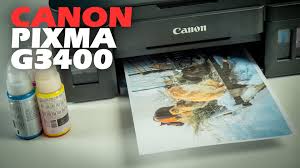
    Canon PIXMA G3400

    The new compact refillable ink tank models combine an aesthetic design and ease of use. The four high-yield, front-facing ink tanks are immediately visible, making it simple and fast to check ink levels, while the uniquely designed ink bottles make topping up a quick and mess-free task.

    Connected creativity

    For connected printing, the PIXMA G3400 is Wi-Fi enabled and offers to print without wires from a PC as well as smartphones or tablets, with full compatibility with Canon’s new PRINT app. Cloud printing lets you send documents and photos to print from anywhere in the world, and remotely print from popular services including Instagram™, Google Drive™, Facebook™, Dropbox™ and Flickr ™.

    For truly creative photo printing the PIXMA G3400 is also compatible with Canon’s Easy-PhotoPrint+. Accessible from tablets or a web browser, the software accesses your photos and lets you edit them before printing creative projects such as greeting cards or calendars.

    The new printers all come with Canon’s My Image Garden software, which includes a range of applications including Creative Park, helping you print a variety personalised creations including cards, crafts, and even high-detail paper arts.

    About Canon Central and North Africa (CCNA)

    Canon Central and North Africa (CCNA) is a division within Canon Middle East FZ LLC (CME), a subsidiary of Canon Europe. The formation of CCNA in 2015 is a strategic step that aims to enhance Canon’s business within the Africa region – by strengthening Canon’s in-country presence and focus.

    CCNA also demonstrates Canon’s commitment to operating closer to its customers and meeting their demands in the rapidly evolving African market.

    Canon has been represented in the Africa continent for more than 15 years through distributors and partners that have successfully built a solid customer base in the region.

    CCNA will ensure the provision of high quality, technologically advanced products that meet the requirements of Africa’s rapidly evolving marketplace.

    With over 100 employees, it will manage sales and marketing activities across 44 countries in Africa.

  • Nigerian Breweries Expands Consumer Market with Premium Stella Beer

    Nigerian Breweries Expands Consumer Market with Premium Stella Beer

    International Premium Stella Lager Beer has been Launched to the Nigerians consumer Market.

    Nigeria’s biggest brewer, Nigerian Breweries, on Wednesday launched the new brand the brand to change the style and trend of the consumer market.

    Present at the unveiling in Lagos were representatives from Nigerian Breweries, including  Marketing Director Nigerian Breweries Franco Maria Maggi, Portfolio Manager Premium Lager Brands Tokunbo Adodo, Brand Manager Global Brands Oreoluwa Kolawole, amongst others.

    he Nigerian Breweries said it launched the premium brewed International lager beer for the satisfaction of millions of beer lovers in its stable of quality for exciting consumer experience.

    Maggi while addressing the forum

    Speaking on the launch of Stella Lager, Marketing Director, Nigerian Breweries Plc, Franco Maria Maggi, said, the new larger beer was birthed in 1897 and crafted by Belgian Master Brewers with very innovative and unique brewing technique adding that Stella Lager Beer is original in its recipe and brewing process.

    “Nigerian Breweries is passionate about delivering quality and consistent value to our consumers. We are excited by the wide acceptance our products continue to receive amongst consumers. Over the years, we have worked hard to earn the trust of our consumers, introducing Stella Lager Beer is our way of assuring millions of beer lovers that we will continue to innovate to deliver superior products and value to them at every ask.”

    Unconventional in its recipe, brewing process and taste, Stella Lager Beer is unique for its name, its great quality, and its premium heritage. It delivers a refined and consistently smooth lager taste with intense refreshment. It is the preferred choice for upwardly mobile, knowledgeable and confident young Nigerian men with a genuine sense of self in a world buzzing with many loud and conflicting voices.

  • Lucky fibres supports rullion Women Entrepreneurship Fair

    Lucky fibres supports rullion Women Entrepreneurship Fair

    Rullion Capacity builders has announced the second edition of the Women Entrepreneurship Fair (WEF), billed to hold at the Nigerian Ports Authority (NPA) grounds in Surulere Lagos, today.

    Lucky Fibres Ltd, manufacturer of Interior designs and floor coverings, Nobel Carpets, Rugs and Yarn products and also a major sponsor of the fair will be exhibiting its newly introduced product LUSH Hair – a new hair extension at the fair.

    The General Manager of Lucky Fibre Ltd., Jitesh Pamnani said: “We are thrilled to be a part of WEF 2.0 event considering the huge participation and impact at the maiden event.

    WEF1.0 was a good platform to reach one of our core target groups women, who are key decision makers in the home”.

    We recently introduced a new line of product, Lush Hair to compliment the already booming beauty and lifestyle industry. LUSH Hair is made of high quality fibrethat is long-lasting and reasonably priced. We will be exhibiting and selling our product at the fair and customers stand the chance of winning amazing products when they visit.

    Managing Director Rullion Capacity Builders Foundationand organiser of the fair Mrs Oluwatoyin Egedi, said: “the success of the previous edition is the drive behind this year’s event. Our goal is always to make WEF memorable for families. We understand that the year has been challenging for many families however this should not take away the happy times family should share”.

    Furthermore we want to avail women in the Micro, Small and Medium Enterprises (MSME) the access to a direct market as well as the opportunity to showcase their wares most of which are products of our training system at Rullion Capacity builders.

    The fair is billed to be one of the biggest in Lagos state with an estimate of 100 purchase stands of various productsand 6,000 individuals including celebrities and Government officials. We are thrilled to have Lush Hair, a new product from Lucky Fibres Ltd as one of our major sponsors.”

    Customers at the fair will also have opportunity to procure different range of Nobel Carpets flooring solutions at discounted rates.

  • Our Mosques, our problem

    Preamble

    As promised here last Friday, today’s article is supposed to be the second part of a letter addressed to Nigerian Imams in this column last week. But by professional norm in journalism it is absurd to serialize articles except by exigency. That is a major difference between a columnist who is a professional journalist and one who is not. It is hoped that the letter published in this column last friday was read and well comprehended by the Imams to whom it was addressed.

    In that letter, a brief history of Islam in Nigeria was recalled to illustrate the point made in respect of some inadequacies of Qur’anic schools in Nigeria. That part had to be summarized because some of the addressed Imams, being men of knowledge are capable of understanding it, even beyond its contents both esoterically and exoterically. The supposed second part of the letter, as earlier indicated, is about our Mosques and the major problems arising from them for the Ummah.

    There can be no talking of the Mosque without fundamental reference to Imams and the congregations they lead. Actually, nothing is called the Mosque without the Ummah and their Imams.


     Imams and leadership training

    When Prophet Muhammad (SAW) described learned scholars as the heirs to the Prophets he was referring to the Imams. This is because no genuine Muslim is supposed to be an Imam without first being a learned scholar. there is a sharp difference between a scholar and a learned scholar. The one can be self-arrogated, the other is intellectually evident.

    Becoming an Imam, if due process is followed, is like becoming a judge after a period of certified experience acquired subsequent to graduating from the Law School. It is not enough to graduate from a Qur’anic school and teach the junior ones for a few years to be qualified as Imam. Lawyers go to Law School after graduating from the Universities. Doctors go for Houseman-ship after their admission into the Profession just as other professionals go for practical industrial training in their respective fields of discipline.

    Apart from graduating from Qur’anic or Arabic and Islamic schools, where do our Imams train as Imams? The answer to this question is that a glaring vacuum still exists for Nigerian Muslim Ummah to fill.

    One of the first problems arising from appointing Imams in Nigeria is lack of leadership training. Here in Nigeria, People are mostly made Imam only on the basis of the little they might have learnt from the Qur’an and Hadith or on the basis of heritage (i.e succeeding a father or a grandfather who had been made an imam before). The aspect of dealing with the complexity of human nature, which is the real quality that is supposed to make a person an Imam, is always over-sighted. And even after coming into office as Imam, no special training is ever organized to enable the leader know the enormity of his duty and map out the strategy with which to handle it. No written document is handed over to the new Imam to show where the last Imam stopped and where the new one should take off from. In other words, no records of activities or of achievements are available in our Mosques except by oral transmission and no blue print is prepared by a newly appointed imam. How can there be progress?


    Imamate  office

    Whereas an Imamate office is such that requires periodic relevant courses, workshops, seminars, conferences and trainings, none of these is ever arranged to update our Imams and improve their quality. Thus, our Imams remain static in the belief that they have attained the peak of Islamic knowledge having become Imams. The danger here is that such Imams will not only refuse to see intellectual progress in any other person, they will also resort to envy and oppression since they are not aspiring to attain higher pedestal in knowledge. And in the melee, they will solicit the support of some money bags but ignorant members of their congregations who have been given titles to wrestle down their perceived rivals. This kind of situation has dismantled many large congregations with resultant effect of proliferation of Mosques even where unnecessary. Some Mosques have even come under lock and key for a long period as it has happened in many parts of south west Nigeria in recent times, thereby leaving the congregation stranded


    The Prophet’s recommendation

    Whereas the Prophet’s recommendation for Imamate is that one should only become an Imam when legitimately chosen and appointed, the situation in Nigeria today is the direct opposite of that recommendation. In the cause of appointing an Imam, Muslim groups gang up against Muslim groups just as families pick quarrels and hostilities against families. Yet, the claim is that they want to serve Allah.

    If those fighting to become Imams knew the implication of serving in that office and reporting back to Allah, they would never have even presented themselves for the post. An Imam is the spiritual guarantor of his congregation. He takes responsibility for any spiritual misdemeanor committed by any member of that congregation before Allah.

    But like any other thing Nigerian, Imamate has been grossly monetized and thus the process of putting people in that office has been seriously corrupted. That is why most of our Imams are half-baked intellectually and even bankrupt morally.


    Office of Muadhdhin

    Ironically, what the Prophet recommended for competition is the office of the Muadhdhin. That office was the very first ministry established by the Prophet shortly after he was appointed a Messenger of Allah. It is the Ministry of Information. The importance attached to that Ministry and the rewards accruing to the Minister in charge were such that even the Prophet sometimes wanted to play the role of a Muadhdhin. The first Minister in that office (Bilal), a liberated black slave from Abyssinia who embraced Islam had to be personally trained by the Prophet even as he was handed over to Zayd bn Thabit for thorough literacy. The purpose was to ensure that he did not misrepresent Islam or the Mosque or the Prophet in any way. That shows how important information is in Islam. But here in Nigeria, especially in the South West, no office is worse relegated than that of the Muadhdhin. It is an office which anybody at all can be asked to occupy. And in no other aspect of the Mosque is ignorance more exhibited than that of the Muadhdhin. Some Muadhdhins can hardly recite correctly the traditional call to prayer which is their very first duty. Yet, the Imams do not care to train or correct them since that office, to them, is immaterial.

    Prophet Muhammad (SAW), who initiated the Ministry of Information and advised Muslims to vie for its occupation did not do so in vain. Without dissemination of adequate information, Islam would not have spread beyond Makkah. And today, the world has come to realize the effect of information dissemination in propagating an ideology or even selling a product. The Jews and the Americans can testify to this fact. Yet, that very aspect of Islam is the main victim of relegation in our Mosques. The connotation here is that you can only advertise a product you posses effectively if it has a sellable quality. Most of our Imams do not value publicity because they lack the quality with which to promote the product in their possession.


    Functions of the Mosque

    When the Prophet established the Mosque, he did not design it for Salat alone. He knew that Muslims would seek knowledge and therefore attached school and library to it. He knew that by the nature of Islam, Muslims would always need to clean up before offering Salat. He therefore attached toilets, baths  and ablution place to the Mosque. He knew that members of his congregation would disagree and seek resolution or redress. He therefore attached court to the Mosque. He knew that some Muslims would fall sick and require medical care. He therefore attached clinic to the Mosque. He knew that there would be need to plan strategy for propagating Islam and for protecting Muslims against internal or external aggression. He therefore attached a deliberation forum to the Mosque in the name of parliament. He knew that his congregation would need a secure place to keep their money and other valuables and therefore attached a treasury (now called bank) to the Mosque. Thus, the Mosque is the center of all Islamic activities including buying and selling.

    Today, all these have virtually been severed from our Mosques and that is why Nigerian Muslims are contented with just a small space to build a small Mosque where they can just offer Salat and disperse. Even in doing this no thought is ever given to any possible future increase in the population of the congregation. The result is that most of our Mosques have no space for anything other than Salat.


     Imams as leaders

    Imams are supposed to be leaders by the grace of Allah, not just because they lead their congregations in Salat but much more because they guide the Ummah aright and admonish them against wrongdoings. They are typically what Prophet Muhammad (SAW) called shepherds. And their congregations are their herd. But there are questions to ask here: when last did our Imams take the census of their congregations to know the gender delineation of their followers? How many people in their congregation are adult and how many are youths? How many members of their congregations are employed? How many are not employable but encouraged with training and counseling? Why are the employable ones among them not employed? How many professionals are in their congregations? Of what use are they to the Mosques? How many in their congregations are married? How many are qualified for marriage but not married? Why? How many are widows and widowers? How many are orphans or aged? How many of them are sick and hospitalized? How many have withdrawn their wards from schools either for loss of jobs or for lack of financial ability to keep them in schools? How many are indebted? How many are imprisoned and for what reasons? What role do the Mosques play in the lives of all these members of their congregations?

    Except for the rich ones among them on whom they confer titles, how many have they periodically visited at home as a matter of courtesy or as a way of encouraging them to keep coming to the Mosque? How many have they counseled socially, politically, economically or matrimonially if only to help them morally or psychologically in solving their problems or in furthering their progress? If these imams drop dead today (and death can come any time) how many members of their congregations will sincerely miss the Imamate in them?.  Perhaps another fundamental question may be necessary here. Do their Mosques have bank accounts?


    Mosque buildings

    Our Imams should know that the buildings which we call Mosques are not meant for Salat alone. Those buildings are like beehives of activities for Muslims to solve their spiritual and mundane problems through interactions with their fellow brothers and sisters as well as through the guidance of their Imams. Besides following them in observing Salat and listening to their sermons every Friday, Our imams should know that Muslims who are regular in their Mosques have a right to some material benefits if only in kind?


    Material benefits

    The real essence of the third pillar of Islam (Zakah) is to enable some under-privileged members of the congregation to benefit materially from the Mosque. If Zakah is not organized by the Mosques in terms of collection, distribution and administration, how will Imams be able to fulfill these obligations? Most members of the congregations are indifferent to the payment of Zakah for two reasons: (1) they do not trust the managerial abilities of their Imams to handle huge amount of money or other treasures coming through them because they have seen eagerness for wealth acquisition and avarice in most of those Imams. In other words, they believe that most of those Imams struggled to become Imams for self-enrichment. And that alone has eroded the dignity of that supposedly venerable office. (2) Most of Those Imams cannot emphasize the payment of Zakah to their congregations because they are not knowledgeable enough about zakah and minimum taxable amount of wealth (Nisab) from which Zakah is supposed to be paid. The disagreement among those imams on this has created doubt and dilemma in most of them.


    Mosque without Zakah

    If the above points had been made very clear to Nigerian Muslim congregations, the amount of money accruable to our Mosques from Zakah would have helped tremendously in solving most of the pecuniary problems that are throwing most poor Muslims into the field of begging. This is a further evidence that population is the main wealth of Nigerian muslims today the utilization of which is not explored for the benefit of the poor and the indigents. However, rather than studying the rules of Zakah and explaining them to their congregations, most Imams prefer to run after rich Muslims in pursuit of Zakah for themselves. They have forgotten that whatever amount they collect as Zakah is not fully meant for them but for the poor members of their congregations and projects needed by the mosque as they (Imams) too must pay Zakah as a compulsory fulfillment of an Islamic obligation.

    The topic here today is not about Zakah. But touching it briefly as just done is to show how the Mosque can effectively maintain social welfare for the Ummah. And that can restore the confidence of the congregations in their Imams. The issue of Zakah will be fully addressed in this column in the near future In sha’a Llah.

    That our Mosques have not lived up to expectation is not the end of story. Righting the wrong is one of the foremost characteristics of Islam. It is better to be late in doing the right thing than not doing the right thing at all. We can still start to put things right as from today.

    Our Imams can start by taking the census of their congregations with a view to knowing their followers more closely. They can start by setting up committees for social welfare; for education; for health; for conflict resolution; for Zakah; for guidance and counseling; for economic growth and skill building; as well as for information and publicity. Each of these committees should have experts in the listed areas as their chairmen. And then, a central body headed by the Imam or a competent person should be put in place to oversee those committees and direct them as to what to do and how to do it. As a matter of trust and sincere commitment to the service of Allah, no Mosque should operate without a bank account which in Islamic parlance is called treasury ( Baytul Mal) which should serve as the power house of the Mosque.


     Conclusion

    As a Muslim community, we have lived with a system for hundreds of years without achieving the necessary objective. In the process, we have lost most of our best hands and even our best heads to the other side of the bridge. We cannot afford to surge ahead with an unprofitable attitude. We must change the system! The Muslim Ummah must be made to see why they need the Mosque as much as the Mosque needs them. Experimenting with a new system will not only put a stop to basking in the euphoria of the past, it will also engender a durable legacy for the current generation of Nigerian Muslims. Our attitudes as true Muslims must conform with the divine rules and regulations of Islam.

  • Molfix wins diaper war with 44% market share

    Molfix wins diaper war with 44% market share

    Two years after Hayat Kimya made entry into the Nigerian market, its premium diaper brand, Molfix, has taken 44 per cent market-share, according to the market report of AC Nielsen. Molfix which was previously a market challenger has eventually eclipsed Pampers share of the market. Pampers, the initial market leader now struggle to hold a 37.3 per cent market-share while Huggies, Nice Baby, Dr. Brown, Dry Love, Little Angel and other brands have been pushed to a lean market-share of 18.4per cent.

    Earlier in the year, Molfix invested $100 million into production, erecting an ultra modern diaper/tissue factory in Agbara Industrial Layout, Ogun State. Molfix drove the competitors into a price war and supported its operations with backward integration and power generation. Molfix has surpassed its projections of owning 30 per cent of the market by 2018 by 14.3 per cent and also achieved within 2/3 of the targeted period.

    Molfi’s brand slogan is “happy babies” with a focus on global quality. The brand has earned an ISO 9001 quality assurance certificate. Mothers who use it for their babies said “it provides dryness and comfort”.  With a combination of physiological and psychological attributes, Molfix  has warmed its way into the hearts of Nigerian women, who previously shopped for foreign alternatives and cost effective diapers.

    Molfix, produced by Hayat Kimya Nigeria Ltd, is said to be cheaper and significantly offers quality. The manufacturer says the product is designed to give “babies full protection and keeps their skin dry and healthy around the clock”. Hayat Kimya, which started producing Molfix baby diapers in 1998 in Turkey, presently has production centres in Algeria, Iran and Egypt. The company came into Nigeria in 2015 when Pampers owned 41.9 per cent of the market share. However, marketing drives and product development strategies have helped the company to take market leadership in a short time.

    Commenting, Managing Director of Hayat Kimya Nigeria, Hakan Misri said: “I’m very proud to be part of this success and lead great Nigeria team.” The company plans to churn out more innovation and also produce more customer-centric products for the “happy babies”.

  • Why Twitter eased 140-character pain

    Why Twitter eased 140-character pain

    Twitter is giving you more characters to express yourself. The social media platform increased its characters limit from 140 to 280 with effect from November 7, 2017.

    According to Aliza Rosen, Product Manager for Twitter: “Trying to cram your thoughts into a Tweet – we’ve all been there, and it’s a pain”.

    Earlier in the year, Twitter carried out a research which shows that the character limit is a major cause of frustration for English-speaking users while it is not a problem for the Japanese. “This is because in languages like Japanese, Korean, and Chinese you can convey about double the amount of information in one character as you can in many other languages, like English, Spanish, Portuguese, or French,” said Rosen.

    Understanding that Twitter is all about brevity, the company however believes that 280 words will help users better to express themselves, without editing sentences and using abbreviations often. However, Twitter users are emotional about the change and believe that the app will become cheesy when more words are used. People are expressing their disappointment at the change, which Twitter called: “new, still brief, constraint”.

    English novelist and author of Harry Porter, JK Rowling’s reaction was devoid of optimism.

    She said: “Twitter’s destroyed its USP. The whole point, for me, was how inventive people could be within that concise framework.”  The entrepreneur and public speaker, Scott Eddy lamented: “Hey #Twitter, instead of giving us 280 characters, how about giving us a few more characters in the bio?”.

    In a mocking tweet, a South-African user, Lwazilwaphesheya K. said: “Twitter went from 140 characters to 280.Then from 20 characters in the space given for a name to 50 characters. Next thing we’ll be sending PDF’s up in here.”

    Here in Nigeria, Twitter users and social media influencers are also complaining over the extension of Twitter characters to 280 words. In a tweet, popular blogger and influencer Japheth Omojuwa wrote: “Twitter was confused on the business side but got the technical side right. With 280 characters, convergence on confusion is imminent.”

    From the research carried out by Twitter, only 0.4 per cent of tweets written in Japanese exhausted the 140 characters space; while nine per cent of tweets sent out in English exhausted the same space. The implication is that more of people who tweet in English need more than 140 characters as more characters are needed to compose words.

    In the month of September when the 280-character extension was tested with few users, Twitter discovered some advantages. Some of the findings are: more space makes it easier for people to express themselves; users are still able to keep twitter’s brevity; and more room to tweet results in more engagement.

    In response to users’ outrage, Alan Rosen wrote last week: ”We’ll continue listening and working to make Twitter easier for everyone while making sure we keep what you love.”

  • ‘Perception created by #AnambraDebates’

    Channels TV recently organised a debate for few governorship candidates in Anambra State, ahead of the coming election. Only candidates of the People’s Democratic Party (PDP); the ruling All Progressive Grand Alliance (APGA); the United Progressive Party (UPP); the All Progressives Congress (APC); and the People’s Progressive Alliance (PPA) were invited for the televised debate tagged #AnambraDebates.

    The debates introduced the antecedence and ideology of each of the candidates. Most importantly, it highlighted the personality brands of each of them. Perception played a big role in the traction received by each of the candidates during and after the debate.

    Godwin Ezeemo of PPA lost the interest of viewers when it became clear that he only moved to Anambra five years ago. He looked like a nascent politician but sounded promising.

    Tony Nwoye of APC put up a dull appearance in terms of dressing and delivery. His demeanor was devoid of executive confidence and intellectual facade. He sounded like the victim.

    Oseloka Obaze of PDP stole the show. His elocution and delivery was outstanding. He sounded like the major challenger.

    Osita Chidoka of UPP has always been popular among the elites. His dressing, composure and candour delivered the excellence he has always been known for. His programmes were spectacularly themed in Igbo language. He seems to be creating a political niche for himself.

    Incumbent Governor Willie Obiano did so well in explaining how he has been driving development in the state. Obiano was obviously tensed as he came face-to-face with his challengers and launched vitriolic attacks on their personalities. He sounded like the opposition.

    However, we look forward to see if perception and personality brand have influence on elections. This election is a referendum, says Osita Chidoka. Perhaps a referendum on the kind of personality widely accepted by the people; this Saturday shall reveal.

  • How internet could kill business

    How internet could kill business

    Internet may kill some businesses, even if they reside on the web. The year was 2001 when Marketing Strategist, Michael E. Porter wrote in Harvard Business Review that internet will jeopardise competitive advantage. Fast-forward to 2016 when almost everybody is on the internet, everybody on the internet claim to be a professional, facebook is seen to be more efficient than billboards and twitter breaks news faster than cable-based televisions.

    The internet has brought a bank of data nearer to companies than researches have ever done. Companies may now be victims of extreme competition, as all information about them, their strategies, product portfolio and clients can be gleaned from the internet. It is easy for competing companies to copy each other and whatever Unique Service Proposition (USP) means is sunk in competitive convergence. Therefore, the need for digital capabilities emerged as the trends change faster. Only companies that are fast developing new capabilities will survive.

    Perhaps the worst harm the internet is doing to the business landscape is the opportunity given to everybody to be whoever  he/she wants to be on the web. Amateurs can launch a website, which is even more competitive in contents than the websites of professionals. Online content has superimposed the need for value and structures; social media savoir-faire is the new professionalism; and copied pictures and false testimonials seem more adequately credible.

  • BOGAS disrupts LNG retailing

    BOGAS, a division of Dangote Group, has started retailing Liquefied Natural Gas (LNG) across Lagos. With hundreds of franchisees across the city, the objective is to take over the gas retail market by providing free home delivery of branded cylinders, with a seal of confidence and safety.

    BOGAS, registered as Borkir International Company Limited, was incorporated in 1999 as a gas trading, distribution and cylinder bottling company. The company has been distributing the filled branded cylinders across communities in Lagos. The cylinders are branded with “Dansa” and “BOGAS”.

    Findings revealed that 12kg gas will go for N3,600 from BOGAS franchise-partners, while same volume of gas is being sold for N4,000 to N5, 000 by road-side retailers. Also, BOGAS delivers in their branded cylinders in exchange with the cylinders of buyers.

    Dangote Group’s entry into the oil and gas industry will change the landscape and refocus the sector for consumer marketing. Dangote Refinery, a $12 billion investment, is expected to be completed in 2019. The launch of BOGAS is thus a reflection of the group’s strategy direction. With a lot of value proposition and benefits to households, BOGAS is set to disrupt the market and reshape it into a value-driven one.

  • What to expect today: Black Friday at Lagos Trade Fair

    Today has been declared as Black Friday by Lagos Chamber of Commerce and Industry (LCCI), the organisers of the Lagos International Trade Fair. It said the Black Friday will witness more discounts on products at the fair.

    The Lagos International Trade Fair, which started on November 3, has attracted hundreds of brands. The brands range from fast-moving consumer goods (FMCG) to industrial produce. Before today, visitors have been buying products at promo prices.

    A young lady, who introduced herself as  Stephanie said: “You don’t know how happy I am to have this.” Stephanie was a able to get a blender for N4, 000 and she was given an additional kitchen item free of charge.

    According to Sola Oyetayo, chairman, Trade Promotions Board of LCCI, people should expect to get products at ridiculously cheap prices today. The furniture section at the fair has the likes of Lifemate, Bedmate and Master Furniture with big show rooms stocked with irresistible designs and architectures. This writer found some furniture items offered at 60 per cent discounts. Kwese TV and Startimes are also at the trade fair and people, who visited their booths enjoyed special offers. Also at the fair, Foton buses are being sold at cheaper prices. Instant gifts are being shared inside Tecno Mobile’s booth.

    The trade fair is full of wonderful experiences. Entertainment in form of music and dancing is going on at every section. Religious brands are also being showcased. Full Gospel Business Men Fellowship International (FGBMFI) sets up a meet-and-talk area, where professionals, who are interested in knowing more about the group are welcomed. Mountain of Fire Ministries (MFM) is there displaying spiritual books and also at the fair with a small team of choirs to provide spirit-filled musicals. Most interesting is the parade of food canteens at the trade fair. They offer sumptuous home-made-kind-of meals, which are also at ridiculously cheap prices. This writer also discovered a cozy air-conditioned room fitted with lighting gadgets, where the creative imaging company, Studio 24, offers free pictures when you pay for the make-up. Black Friday will be fun here.