Category: e-Business

  • MDXI okays N2.5b for expansion

    • ‘Data domestication’ll curb security’ threats

    An indigenous information technology (IT) firm, MDXI said it has set aside N2.5billion for the expansion of its foothold in the country.

    MDXI is a subsidiary of MainOne, West Africa’s largest full scale data center provider offering colocation, wholesale deployments, interconnection and cloud services.

    It also urged the Federal Government to domesticate data as one way of tackling growing homeland insecurity and also classify data centres as critical national infrastructure for optimum protection.

    Its General Manager, Gbenga Adegbiji, who spoke on the sidelines during a facility tour of the data centre in Ajah, Lagos said, the cash will be spent on the expansion of the facility, and building the largest full scale data center ecosystem across West Africa

    According to him, the firm has investment some $35 million out of the planned $40 million earmarked for building the infrastructure to world class standard.

    He said the facility is eco-friendly saving 18 tons of carbon emission, adding that it eliminates capital expenditure, predict operating expenditure, creates room for flexibility in growth, gives expert technical support, quicker deployment and reduction of uncertainties.

    According to him, MDXI is the gold standard for data centre real estate in the sub-region as it develops a data center ecosystem spanning facilities in Lagos, Sagamu, Accra, Cote D’Ivoire and Senegal.

    He said it is West Africa’s only Tier III facility with PCI DSS, ISO 27001 and 9001 certifications built to TIA 942 & Uptime Institute Tier III Standards.

    PCI DSS ensures MDXI is the natural choice for financial institutions who must guarantee secure card infrastructure while it is resilient, vendor-neutral; only data center with direct connections to four submarine cables within 10km: ACE, WACS, Glo 1, MainOne.

    “With its data center and submarine cable, MainOne operates a central hub supporting West Africa’s connectivity, cloud and data center needs

    “MDXI is the only content aggregator hosting global over the top (OTTs) players in Nigeria and is fully compliant with financial sector 20km distance diversity between primary and secondary data centre.

    “MDXI is West Africa’s telehouse, with proven competence to interconnect major network, content and financial providers; collocating in MDXI gives organisation access to the largest ecosystem of interconnected networks, services and applications in Nigeria. Our customers have direct access to all major telecom carrier and ISP networks in West Africa, with interconnections at multiple peering exchanges (Nigeria, Ghana, Amsterdam, London); it is the home to the sub-region’s biggest internet exchange, IXPN; guarantee 100 per cent power uptime availability.”


  • Global Accelerex unveils Android PoS terminal

    A Central Bank of Nigeria (CBN) licensed payment terminal service provider, Global Accelerex, has unveiled NEXGO N5, the first single unit Android point of sale (PoS) terminal to be certified for payment acceptance in Nigeria.

    The device runs on Lollipop 5.0 operating system (OS) and performs four times faster than any other payment terminal around. It has efficient battery conservation and high performance; it is loaded with better protection against vulnerabilities and malware, giving users peace of mind that allows them to focus on running their businesses effectively.

    Commenting on the product, its Chief Technology Officer, Mr. Stanley Peters, said: “We remain committed in our determination to deploy the best available PoS systems in the world into Nigeria; we will leverage technology to make payment systems faster, safer and more dependable. The unique terminal offers improved network selection logic, limited interruption of connectivity and standby power time of 120 hours, lasting up to five days before the battery drains out.”

    Its Chief Operating Officer, Mr. Kayode Ariyo, said the introduction of the terminal marks another milestone in the quest to revolutionise PoS business in Nigeria with the most efficient payment solutions. He reiterated the company’s bias for world-class technology, excellent service quality and innovation.

    Packed with a Quad-Core processor, the smart terminal enables users multitask – giving them the luxury to perform multiple functions on the PoS terminal, without it slowing down or hanging. The processor also encourages lower power consumption and higher performance per watt.

    It comes with a lot of applications for the enhancement of business operational efficiency. It generates coupons for sales promotions, creates sales records, creates invoices for merchants such as warehouses, retail outlets and others, inventory management which include monitoring the stock, re-order level and automatic replenishment systems.

    It has certification which include PCI – certification of payment data security by international standards; EMVco – evaluates the security of a payment card before a transaction is approved; Visa – for smooth transition of card and contactless transactions; Mastercard – enhances functional reliability, interoperability and overall security; and AmEX, which enables international card acceptance and seamless transaction approval.


  • Interswitch makes fresh intervention to revive STEM education in Nigeria

    Interswitch makes fresh intervention to revive STEM education in Nigeria

    An integrated digital payment and commerce company, Interswitch on Wednesday said it has kicked off a special intervention program that will revive the fast declining interest of Nigerian students in Science Technology Engineering and Mathematics(STEM) education with over N20Million valued initiative Tagged; Interswitch SPAK.

    The initiative, the company said, is targeted that at resuscitating students interest in the face of the challenge of poverty, poor school funding, waning interest from students, to poorly trained teachers, inadequate learning aids, incessant strikes, among others that have been identified as the factors militating growth of STEM education in the country.

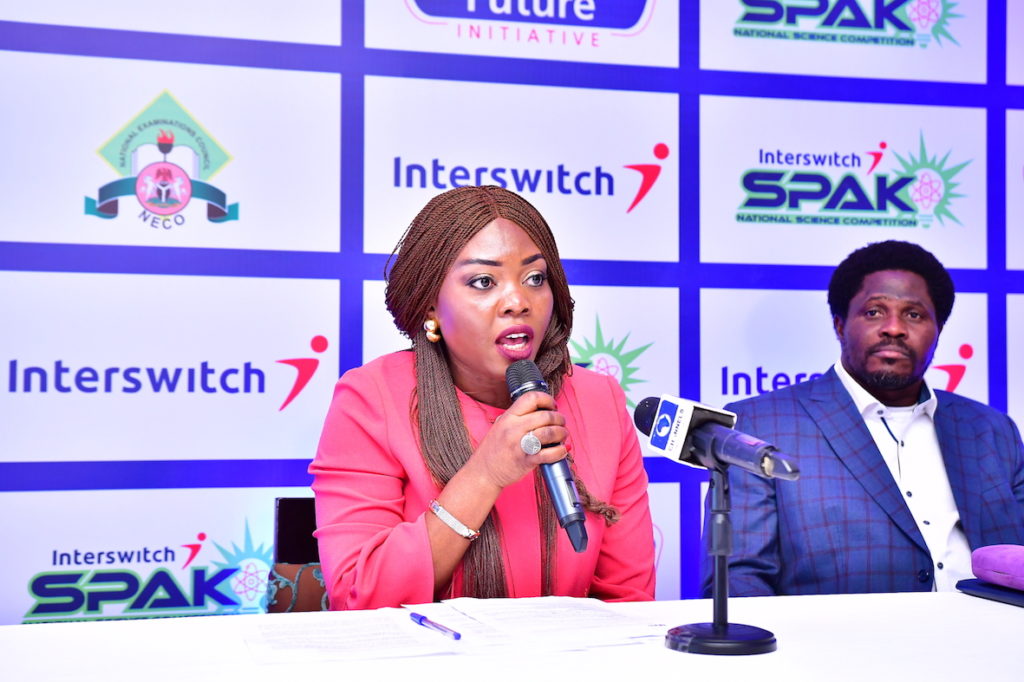
    Speaking during the launch of the inaugural initiative, Chief Marketing Officer, Interswitch Group, Cherry Eromosele reckoned that Nigerian students are largely uninspired to pursue their passion in STEM related fields, thereby leaving them unprepared for the opportunities and challenges of the 21st century world.

    And that owing to existing incompetence levels, a large number of jobs in Nigeria’s employment ecosystem have been outsourced to expatriates.

    She however explained that with Initiatives like the SPAK the trend will be reverted and on the long run there will be an increased competitiveness and improve employment levels for Nigerians.

    She further explained that “To kick start the initiative, a national science competition is set to begin in April 2018. The competition will feature students from all states of the federation competing in core STEM subjects like Physics, Chemistry, Biology and Mathematics.

    “We are ready as part of our Cooperate Social Responsibility (CSR) as company is to provide the right support and reward for students and other stakeholders who will avail the SPAK nationwide initiative designed to promote STEM education among Senior Secondary School students.

    “We are targeting year 11 students only,( SS2 students) for this SPAK pilot scheme. We want six best students from each school to be registered for the initiative. We have tried to be gender balance by stating that at least two female students must be registered among the six participating students as part of the registration prerequisite.

    Chief Marketing Officer, Interswitch Group, Cherry Eromosele speaking during the launch of the Interswitch SPAK.

    “The registration has started already and schools can fill the form online for free through the Interswtich SPAK website. The registration will last for eight weeks after which we will conduct a national level competition in conjunction with National Examinations Council (NECO).

    “The first students in the competition will be awarded with N7.5Million -five-year university scholarship, a Mac laptop and gold trophy; the second will receive a N4.5Million-three-year university  scholarship, a laptop and a silver trophy ,while the third person will get N1Million -two-years scholarship, a laptop, and a bronze trophy.

    “We understand that a lot is needed to be done to get it right but as a matter of cause-and-effect, we hope this initiative will open more doors of opportunities for improved STEM skills at the grass roots, equal greater employment, lower rate of job losses, higher exports and a direct positive impact on Nigeria’s GDP.”

    Registrar, NECO. Prof Charles Uwakwe with Chief Marketing Officer, Interswitch, Cherry Eromosele at the Interswitch SPAK Launch in Lagos.

    According to the Registrar; National Examinations Council (NECO), Professor Charles Uwakwe who lauded the initiative was optimistic that it will invariably increase student interests and enrollment in STEM subjects, among other benefits.

    He stated that the examination body has thrown it full weight behind the initiative by providing provision for technical supports to ensure that schools get adequate motivation for their participating students.

    He added; “While STEM education may have been plagued by various challenges in the past, Interswitch SPAK is one great step towards ameliorating the situation, and it deserves the support and commendation of every stakeholder.

    “One also hopes that other successful Nigerian tech companies will be inspired by this to create similar opportunities for the nation’s education system.”

    According to research from Brookings – a Washington based research institution – By 2030, more than half of the jobs in the world will be STEM – Science Technology Engineering and Mathematics – based.

    But, how prepared is Nigeria for this reality?

  • Oyo deploys software to manage health

    Government software and consulting services provider NexusMax Software 365, LLC (NEXUSMAX) has deployed a solution to power Oyo State Health Insurance Agency (OYSHIA).

    Deployment of the comprehensive biometric health insurance platform  has increased OYSHIA’s portfolio as a pacesetter in the sector.

    The  system, based on NEXUSMAX’s commercial off-the-shelf NEXUSINSURE software, was implemented by a joint government and private sector team comprising OYSHIA and NEXUSMAX.

    The adoption of the software was to ensure that at least five per cent of the population of the state is enrolled before the end of the first year of the scheme.

    Its adoption has given the agency platform independence as all stakeholders key into the relevant parts of the platform.

    OYSHIA’s Acting Executive Secretary, Dr. Olusola Akande, said the agency chose NEXUSINSURE   because it offers one-stop-shop platform to manage the activities of the agency.

    It is also equipped with a comprehensive biometric data capture, which is critical when verifying enrollees at the point of accessing health care in the state.

    The agency went live with the new system in July 2017 on schedule. The system allows all stakeholders such as HMOs, hospitals and enrollees to do many things online, including payments, renewal of premiums, and biometric registration of enrollees.

    “One of our major goals was to ensure—from day one of production—that this system would continue to support our operations and provide an improved customer experience without issue. Our team accomplished this goal. The system streamlines our processes and allows us to serve our customers with greater accuracy and efficiency,” Dr. Akande said.

    From the portal, access to information on the progress of the scheme can be viewed. It also powers HMO Portal, a private portal for all HMOs involved in the scheme. Subscribers can change their providers, manage their dependents and perform self-service functions through the internet or text message.  The provider portal allows providers to be partners.

    They can download enrollee lists, verify their identification, lodge their claims online real time, view claims lodged, paid and outstanding. Enrollee verification can be done via text message too.

    Others are CHAs/BOTS/Micro HMO portal which allows provision of first level support to issues that arise, ensuring active response by parties involved.

    NEXUSINSURE also supports different payment channels such as scratch cards, online payment as well as USSD based payment alternatives.

    “Every NEXUSINSURE project has been delivered on time and on budget. This record of success is an important factor for Agencies in Project evaluation,”  NEXUSMAX Director, Wahab Aminu-Sarumi, said.

  • MDXI okays N2.5b for expansion

    • ‘Data domestication’ll curb security’ threats

    An indigenous information technology (IT) firm, MDXI said it has set aside N2.5billion for the expansion of its foothold in the country.

    MDXI is a subsidiary of MainOne, West Africa’s largest full scale data center provider offering colocation, wholesale deployments, interconnection and cloud services.

    It also urged the Federal Government to domesticate data as one way of tackling growing homeland insecurity and also classify data centres as critical national infrastructure for optimum protection.

    Its General Manager, Gbenga Adegbiji, who spoke on the sidelines during a facility tour of the data centre in Ajah, Lagos said, the cash will be spent on the expansion of the facility, and building the largest full scale data center ecosystem across West Africa

    According to him, the firm has investment some $35 million out of the planned $40 million earmarked for building the infrastructure to world class standard.

    He said the facility is eco-friendly saving 18 tons of carbon emission, adding that it eliminates capital expenditure, predict operating expenditure, creates room for flexibility in growth, gives expert technical support, quicker deployment and reduction of uncertainties.

    According to him, MDXI is the gold standard for data centre real estate in the sub-region as it develops a data center ecosystem spanning facilities in Lagos, Sagamu, Accra, Cote D’Ivoire and Senegal.

    He said it is West Africa’s only Tier III facility with PCI DSS, ISO 27001 and 9001 certifications built to TIA 942 & Uptime Institute Tier III Standards.

    PCI DSS ensures MDXI is the natural choice for financial institutions who must guarantee secure card infrastructure while it is resilient, vendor-neutral; only data center with direct connections to four submarine cables within 10km: ACE, WACS, Glo 1, MainOne.

    “With its data center and submarine cable, MainOne operates a central hub supporting West Africa’s connectivity, cloud and data center needs

    “MDXI is the only content aggregator hosting global over the top (OTTs) players in Nigeria and is fully compliant with financial sector 20km distance diversity between primary and secondary data centre.

    “MDXI is West Africa’s telehouse, with proven competence to interconnect major network, content and financial providers; collocating in MDXI gives organisation access to the largest ecosystem of interconnected networks, services and applications in Nigeria. Our customers have direct access to all major telecom carrier and ISP networks in West Africa, with interconnections at multiple peering exchanges (Nigeria, Ghana, Amsterdam, London); it is the home to the sub-region’s biggest internet exchange, IXPN; guarantee 100 per cent power uptime availability.”


  • Furore over registration, licensing of IT contractors

    Furore over registration, licensing of IT contractors

    Two groups, the Nigerian Computer Society (NCS) and the National Information Technology Development Agency (NITDA), are at loggerheads over the registration and licensing of Information Technology (IT) contractors. LUCAS AJANAKU writes on what the development portends to the industry.

    On assumption of office as Director-General, National Information Technology Development Agency (NITDA), Dr Isa Ali Ibrahim Pantami promised to work tirelessly to realise the  mandates of the agency, which was formed on April 18, 2001, but formally got its legal teeth through the NITDA Act of 2007.

    In his inuaugural address to workers, Dr Pantami said: “NITDA, as you all know, is a very strategic agency. It is one of the most knowledge-based government institutions that requires a harmonious blend of knowledge and creativity.

    Section 6 of the enabling law establishing the NITDA and the Nigeria Outsourcing Policy and Institutional Framework for Nigeria (Paragraph 3.3) clearly encapsulates the general thrust of the objectives and functions of the agency. To paraphrase Section 6, the law empowers the agency to plan, develop, co-ordinate and monitor all matters relating to IT practices, activities and systems in Nigeria.

    This is further reinforced in the National Outsourcing Policy and Institutional Framework for Nigeria, which provides that: “The overall policy objective is the promotion of an enabling institutional, legal, regulatory, technological and infrastructural environment for the sustainable development of the outsourcing sector in Nigeria.”

    Perhaps pursuant to his desire to work his talk, he raised the alarm over the failure of Information Technology (IT) projects in government Ministries, Departments and Agencies (MDAs). He lamented that 95 per cent of IT projects’ security in the MDAs is compromised.

    Pantami said part of the measures would be the licensing of all IT contractors and service providers for the purposes of procurements, public private partnerships (PPP) and other forms of engagements.

    Pantami said: “The management of NITDA would like to bring to the attention of all IT contractors, MDAs, other government establishments, the organised private sector (OPS) and the general public that it has put measures in place to register and license all IT contractors and service providers for the purposes of procurements, PPPs and other forms of engagement with government establishments and private sector.

    “The Agency is dismayed at the raising number of failing IT projects within Federal MDAs and other government establishments. NITDA’s investigations revealed that over 90 per cent of IT projects in MDAs and other government establishments failed and more than 95 per cent of their security is compromised.

    “In order to curtail this and in line with the Agency’s mandate and the recent Presidential Executive Order 005 for Planning and Execution of Projects, Promotion of Nigerian Content in Contracts and Science, Engineering and Technology, as mandated by President Muhammadu Buhari, the registration and licensing of IT contractors and service providers have become expedient.”

    He continued:”The process aims at ensuring the emergence of robust indigenous IT service providers and contractors, guaranteeing the delivery of sustainable IT projects as well as engendering professionalism in the IT service industry.

    “The process will also ensure that IT projects in MDAs will only be executed by indigenous companies where in-country capacity exists. As part of the process, NITDA will monitor and ensure the capacity development of Nigerians employed by IT contractors and other service providers.

    “Furthermore, the Agency will, in conjunction with relevant agencies, investigate any project that has failed to determine the root cause of the failure and apply sanctions where necessary or to refer such cases to other relevant authorities.

    “All firms desirous of providing IT services and contracts to Federal MDAs and other government establishments are advised to initiate the registration process with immediate effect. Guidelines on the registration process can be accessed by visiting NITDA’s website.   Alternatively, an applicantion can be written to the agency in order to initiate the process.

    He added:”Interested entities should note that only NITDA registered firms and companies will be recognised as having capabilities for the provision of IT services to Federal MDAs and other government establishments. All MDAs and other government establishments are advised to consult NITDA before any IT firm is engaged for the purpose of providing IT related services.”

    Reacting to the development, the Nigerian Computer Society (NCS) kicked against Pantami’s move to register and licence IT contractors in the country.

    Its President, Adesola Aderounmu said it is not part of NITDA’s mandate because as the name suggests the agency is to plan, promote and develop regulatory framework and guidelines as stated in NITDA Act 2007, Section 6a.

    “The Computer Professionals Registration Council of Nigeria (CPN) Act 49 of 1993 is saddled with the mandate to register, license, supervise and control the profession as stated in CPN Act Section 1 (2).”

    Prof Aderounmu warned that the NITDA’s policy statement was capable of confusing the general public to create an uncoordinated approach to policy issues and both Acts of Parliament as stated earlier. NCS, he said, believes that NITDA’s mandate is to ensure seamless cooperation and interaction towards the use of IT as a development tool for the country.

    The NCS commended the approach and wisdom of the Presidential Executive Order 005 Buhari, which emphasises professionalism.  “The Public Procurement Act 2007 with particular reference to Section 19 if properly implemented will promote best practices professionally. “On a related note the CPN Act Section 22, states that failure to engage professional practitioners is an offence in Nigeria punishable under the Act.

    “We, therefore, advise NITDA in our advocacy capacity not to embark on registering and licensing of IT contractors and service providers (Registered IT professionals) activities and instead concentrate on developmental issues, which we believe can be jointly achieved collaboratively. CPN is the only agency with the mandate to register and license IT professionals and contractors in Nigeria.

    NITDA has said it will go ahead with the registration and licensing of contractors, saying several indigenous contractors and service providers have commenced the process of registration with NITDA, adding that the agency appreciates all those that have initiated the process. “It clearly shows their commitment to the growth and development of the IT sector,” NITDA said.

    While it said NCS was correct that the Computer Professionals (Registration Council) of Nigeria as a council has the mandate to control and supervise the (Computing) profession as provided by Section 1(2) of the Computer Professionals (Registration council of Nigeria) Act, it argued that the registration of IT contractors and service providers by NITDA is in line with its mandate as specifically stated in Section 6 (a,f) NITDA Act 2007.

    It argued further that the section mandates it to create a framework for the planning, research, development, standardisation, application, coordination, monitoring, evaluation and regulation of IT practices, activities and systems in Nigeria. It is also to render advisory services on all IT matters to the public and private sectors.

    “Therefore, it is within the regulatory and developmental role of the NITDA to ensure that IT contractual practices and project delivery in the public sector are done in accordance with best practices, within acceptable standards and in the interest of the development of IT in Nigeria.

    “Furthermore, the agency, as the clearance house for IT projects of the Federal Government, has the responsibility to ensure that IT projects are executed by professional firms. NITDA as a regulator will not relent in its quest to improve IT practices and expose projects that are ill conceived or poorly executed,” the agency said.

    The agency assured all that it will not allow sub-standard projects in ministries, departments and agencies (MDAs) being executed by companies that have limited or no capacities. “The registration process will therefore ensure professionalism in IT service delivery, value for national investments in IT and to weed out quacks who may seek to take advantage of public procurement for selfish interests. The process will also provide a detailed database of indigenous IT capabilities in Nigeria to guide the government in planning IT projects and for the promotion of Nigerian content through appropriate use of public sector spend in IT. Furthermore, the process will lead to a review of failed projects with a view to curating knowledge on factors that may have led to the failure. NITDA in partnership with other relevant authorities shall take appropriate action where fraud may have led to failure,” NITDA explained.

    The NCS has insisted that only the CPN has power to register and licence IT contractors. Prof Aderounmu, who quoted the relevant sections of the law that created CPN, said NITDA is an agency charged with the responsibility of developing the appropriate framework and policies for the smooth running of the industry.

    He said if public sector IT projects had been awarded to contractors registered with CPN, they most likely would not have failed on the massive scale the NITDA DG alleged. He added that the appropriate step the NITDA sould have taken was to report the erring contractors to the CPN and not usurping the duties constitutionally assigned to CPN.

    He said the provisions of Act 49 of June 1993 gave the CPN the mandate to register and licence IT contractors because Section 2(2) of the Act empowers it to register members.

    “Persons admitted to the membership of the profession shall be registered as members of the profession in various categories, including the corporate member category; (under) CPN Act section 8(1), CPN has the mandate to keep, publish, print the list of all registered professionals and the list is available for inspection for members of the public at all reasonable time. This has been in operation since 1998; while CPN Act section 18(2b) deals with licensing. It prescribes the form of licence to be issued annually.”

    “The call for another registration and licensing of IT contractors by NITDA is tantamount to double registration, which is contrary to the Federal Government’s policy on ease of doing business. Furthermore it may lead to the registration of quacks and non-professionals.

    “Failed and substandard public IT projects cited by NITDA should have been reported to CPN for necessary action. IT contracts should only be awarded to CPN registered members; the list is available online and in accordance with Public Procurement Act 2007.

    “Registering and licensing IT contractors is not within the mandate of NITDA which is to create framework, guidelines and policy to develop IT. When properly implemented, it will solve the problem of unemployment in Nigeria which is the focus of the present administration,” Prof Aderounmu said.



  • Expect 5G evolution by Q4, says Ericsson chief

    Expect 5G evolution by Q4, says Ericsson chief

    By Q4 of 2018, Nigeria and other countries in the continent should have 5G radio and core networks connectivity. Head of Networks, Ericsson Middle East, Chafic Traboulsi in this interview has said, stating a $370 million credit facility for R&D to actualise this has been secured.       Excerpt


    Ericsson said it has launched 5G which shall be deployed from the fourth quarter of 2018 How would Africa benefit from this?

    Yes we are finalizing 5G-readiness for operators by enhancing our 5G Platform with new solutions:
    We introduce 5G commercial software for radio and core networks to enable operators to launch 5G in new spectrum from Q4 2018


    To capture growth opportunities presented by new 5G use cases, we expand our 5G Core System offering with new capabilities to support 5G NR and also evolve our Distributed Cloud offering for cloud application deployment across multiple sites – central, distributed, and edge.


    We also introduce a new category of radio products called Street Macro – a new site type that addresses the need of operators to grow in cities with limited available radio locations. It is a layer in network between macro and micro.


    We are also unveiling new radio products supporting Massive MIMO technology – enabling a smooth evolution from 4G to 5G and addressing the need for increased capacity, while simplifying use for wider adoption.


    We also add products encompassing multi-band operation, increased capacity and ease-of-site acquisition.

    In parallel, we are also announcing that all radio products within Ericsson Radio System delivered since 2015 will support 5G New Radio (NR) capability through remote software installation. This means installed Ericsson Radio System (ERS) products that are active in more than 190 networks around the world are ready for 5G NR


    In your opinion, why would operators need 5G?

    All the previous technology generations were basically developed to address only Consumer predominantly (for Voice and Text in 2G to browsing in 3G and Higher speed data and Video in 4G).

    5G will serve consumers and multiple industries and open up new business models across industries.

    In an Ericsson Consumer Lab Study, over 70 percent of consumers said that faster speed, better reliability and lower latency were their top expectations of 5G.  What we can take from this is that 5G isn’t just about new use cases, it’s also about improving the services users already subscribe to.


    Enhanced Mobile Broadband (eMBB) is the first use case for 5G. With the continued growth in mobile traffic, there is a need for a more efficient technology, higher data rates, and spectrum utilization. In terms of consumer digitalization and richer user experience, new applications based on virtual and augmented reality will require higher bandwidths and lower latency.


    Industry digitalization and 5G open up opportunities for operators to address up to USD 619 billion market globally in 2026 (in 10 industries by adding digitalizing of retail and agriculture to previously communicated USD 582 billion). This represents a potential to add up to 36 percent growth in revenues in 2026, with manufacturing and energy/utilities sectors representing the biggest opportunity for revenues created or enhanced by 5G.


    Use Case Evolution to 5G includes the executive summary of use case evolution to 5G with supporting technologies, followed by separate sections for Enhanced Mobile Broadband, Automotive, Manufacturing, Energy & Utilities and Healthcare.

    Fixed Wireless Access (FWA) can provide connectivity for households and Small Medium Enterprises (SMEs) using wireless technologies. Main addressable segments are the unserved areas (i.e., connect the unconnected; representing new revenues for operators) or wireless fiber (i.e., a more cost-efficient way to provide high-capacity connectivity). Operator services may also include telephony and value-added services (e.g., media, security).


    When will 5G be available?

    We and partners have been working with 5G technology for several years in the labs, and last two years we took these technologies into advanced outdoor field trials. We have also signed first 5G deals with Verizon, Swisscom and Vodafone (UK).

    The 5G standardization has been accelerated with first 5G NR standard for NSA (non-stand alone 5G) finalized in Dec 2017 and 3GPP Rel-15 is planned to be finalized by mid 2018.

    And, we see some operators interest tied to number of major upcoming sporting events that will showcase 5G this year.

    From this year onwards we will see full system trials in commercial applications with initial commercial 5G networks and devices based on the 3GPP standards are expected in 2019, with major network deployments from 2020. The first very few 5G devices will likely be introduced towards the end of 2018.

    And we estimate the number of subscriptions reaching one billion by the end of 2023.

    What will happen in next 5 years?

    Industries will be transforming by new capabilities brought on by 5G. Examples of these capabilities include: The ability to download a full-length HD movie in seconds, the quick reaction time (low latency) to enable remote robotics, the ability to spin up virtual networks on-demand with network slicing, battery lifetimes beyond 10 years for remote cellular devices
    This will bring new requirements on the 5G networks. And we estimate the number of subscriptions reaching around one billion by the end of 2023

    (Source; Ericsson Mobility report)

  • Prospects of blockchain

    Prospects of blockchain

    The emerging Internet of Things (IoT) economy will likely continue its steady growth with both government and private sector organisations paying close attention to cloud technology and its enormous potential. Closely linked with IoT is blockchain. LUCAS AJANAKU writes on this emerging technology and its future as private and public organisations move to entrench transparency, profitability and others.

    To the Managing Director, Accenture Technology, Nigeria, Olaniyi Tayo, if 2017 was the year of blockchain early adoption by mainstream businesses, 2018 to 2027 will be a decade when blockchain solutions will disrupt many industries across the world.

    According to Accenture research, by 2025, blockchain will be considered mainstream and integral to the capital market and ecosystem.

    An online platform, investopedia.com said:“A blockchain is a digitised, decentralised, public ledger of all cryptocurrency transactions. … Originally developed as the accounting method for the virtual currency, Bitcoin, blockchains, which use what is known as distributed ledger technology (DLT), are appearing in a variety of commercial applications today.”

    According to Tayo, blockchain offers the chance to truly rewrite the way companies and markets operate by delivering greater transparency and trust, removing redundant processes and revamping inefficient capabilities. Beyond simply automating old processes, blockchain eliminates steps and activities amongst businesses and facilitates the restructuring of traditional value chains.

    From financial industry to healthcare, retail, oil and gas, manufacturing, trade, agriculture, blockchain is redefining ways businesses operate and leading to the ‘Internet of Value’.

    “Accenture is at the forefront of blockchain innovation and its practical, real world application. We recently demonstrated our innovation in Lagos, Nigeria, in December last year. We provided business executives with a view of the blockchain-based technology landscape and its potential business applications. Our global team of experts works with each client to help build and execute smart strategies around effective use-cases and investment.

    “Blockchain has the potential to drive profound, positive change. We are working closely with leaders from across a broad range of industries, governments, consortia, the academic community and our key technology alliances to move the technology forward so that, ultimately, it can help to improve the way the world lives and works,” Tayo said.

    In the financial services industry, blockchain technology undermines the ‘middle-man’ business model. It makes it harder for fraud in transactions and so reduces the value of credibility lent by trusted intermediaries. Therefore, players in this industry will have to re-imagine their business models given this disruption in their value chain.

    Oracle Nigeria Managing Director, Adebayo Sanni, agreed no less with Tayo on the power of blockchain as game changer, but stressed the need for data security as IoT gains more traction within the information communication technology (ICT) ecosystem.

    He said: “Business and government have to remain relevant and competitive if they wish to participate on the global stage and the adoption of cloud and the technologies that surround it are instrumental. As an example, the Nigerian government has prioritised the need for transparency in both public and private sectors and one of the technologies set to address these issues is very likely to be blockchain.

    “Blockchain-based solutions can potentially reduce corruption, and improve government operations efficiency and service delivery. At the same time, we also need to take data security and privacy seriously. In many countries, data sovereignty laws require government and businesses to keep their data in country and these challenges must be addressed if we are truly to transform and position Nigeria as a hotbed of technological innovation in Africa.

    “In spite of these challenges, numerous companies are breaking tradition and creating disruptive waves. Many are creating solutions that are born in the cloud that allow for innovation through agility, quicker deployment and competitive pricing – all disrupting the market and continent in new ways.”

    According to technology experts, the healthcare industry has high hopes for blockchain technology since interoperability, or the ability to securely share medical records across providers and patients, is the driving force behind many technology investments within healthcare. It is widely believed that blockchain will be the technology that will form the basis of securely creating and sharing medical records that will solve many of healthcare’s current issues of siloed stores of data that lead to the delays and administrative burden of sharing health information.

    Every industry must start utilising blockchain technology as a foundation to explore the convergence of a variety of technological tools to address customer-centric needs and social problems that provide excellent business opportunities.

    “Those that take advantage of this will be rewarded with a resilient and anti-fragile digital infrastructure that enables the cultivation of efficient ecosystems, better products and services, lower costs at scale and improved outcomes for all,” Accenture said.

  • NCC: Infracos key to infrastructure deployment

    The Nigerian Communications Commission (NCC), Executive Vice Chairman, Prof Umar Garba Danbatta, has said licensing infrastructure providers (Infracos) is a key step to ensure the deployment of the much needed infrastructure for the telecoms sector.

    Speaking at a panel session of the International Institute of Communications (IIC) and Regional Telecommunications and Media Forum in Singapore, Prof Danbatta said the Commission had to develop innovative solutions to fast-track infrastructure deployment with a view to deepening the nation’s broadband penetration.

    The board of the NCC had issued two additional Infraco licences to Zinox Technology Limited for the  Southeast, and Brinks Integrated Solutions Limited the Northeast, bringing the total number of Infracos licenced to four.

    The NCC chief, therefore, called for the development of human capital, which is in tune with the dynamism of the industry to achieve the desired balanced regulatory intervention.

    “Regulators must consider the idea of having in-house research and development (R&D) units that reach out and collaborate with researchers, academia in order to align and be abreast of technological innovations and trends,” he explained.

    Also, in a paper titled: Building Institutional Capacity and Human Capital: How A Regulator Builds Capacity  That Fits For Purpose In A Rapidly Moving Environment, Danbatta said the NCC would continue to ensure that its institutional structure remains pliable enough to tackle emerging technologies and exigencies of the telecommunications sector.

    He said the commission’s performance has attracted the recognition of numerous reputable institutions both locally and internationally, especially in the last two years.

    “In 2017, the Bureau for Public Service Reforms, Nigeria reviewed the Commission’s structure, processes and work culture, scored it a platinum category and recommended it a model for other public institutions in the country to emulate,” he added.

  • MainOne mulls IT stakeholders’ summit

    MainOne mulls IT stakeholders’ summit

    MainOne will for the third time host ICT stakeholders at its annual flagship event, Nerds Unite. With a focus on digital disruption with the theme: “Radical Digital Transformation”, the 2018 edition will feature a keynote address from the author of Disrupting Africa: The Rise & Rise of African Innovation, Nnamdi Oranye, supported by speakers from companies including Avanti, SAP Africa, Wema Bank, Andela and Microsoft, among many others.

    The event, which will hold in Lagos on February 23, is expected to bring together over 500 mid to senior ICT executives across multiple industries for intense innovation sessions, featuring latest best practices and emerging trends in data center, collaboration, enterprise networking and cybersecurity, among  hot topics.  Nerds Unite is also expected to provide unparalleled networking opportunities with all these professionals under one roof.

    The radical digital transformation being witnessed globally in recent times is the key focus of the event. The event will have four predominant discussion tracks: “Disrupting the Nigerian ICT industry”, “Radical Digital Transformation: Perspectives across industry players”, “Digitalisation and Business” and “The future of mobile content delivery in Nigeria”, with discussions led by executives from leading companies exploring various industries and the digital transformation altering industry verticals. Participants will also be empowered with technical insights on the latest trends as it relates to the realities of the Nigerian environment and how these can be adopted for improved efficiencies for their respective organisations.

    Created by leading provider of network and data center solutions, MainOne and its partners for ICT Executives, Nerds Unite is an annual technology conference hosted by MainOne, which brings ICT professionals across sectors together for impactful technical knowledge sharing sessions and social networking. Last year, the event featured the first ever showcase in Nigeria of Microsoft HoloLens, the world’s first self-contained holographic computer running Windows 10, in addition to representation by the Internet Society and a keynote by Microsoft.